Are xAI and OpenAI going public? 2026 may be the year of AI IPOs
It's only the beginning of 2026, and Wall Street is already lining up with IPO prospectuses. In 2013, Musk stated that SpaceX would never go public, but recent news indicates he's combining rockets and AI; SpaceX and xAI plan to merge and go public this year. The IPO is expected to reach a valuation of $1.5 trillion. What made Musk suddenly change his mind?
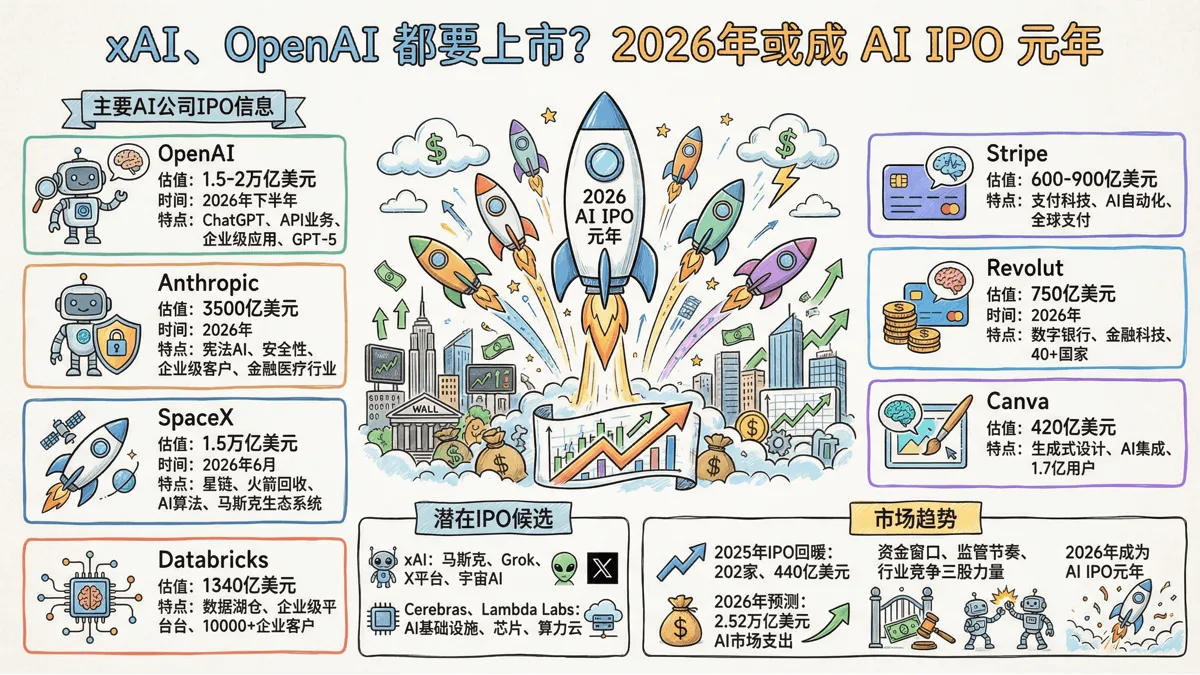
The year 2026 has just begun, and there is already a long queue of prospectuses on Wall Street.
In 2013, Musk said that SpaceX would never go public. However, the latest news shows that Musk is going to combine rockets and AI. SpaceX and xAI plan to merge and go public this year. The IPO target valuation may reach US$1.5 trillion. What made Musk suddenly change his mind?
OpenAI is preparing for an IPO in the fourth quarter and wants to be the first to enter the market before Anthropic;
Anthropic, which has always been low-key, also quietly hired a lawyer;
Databricks, Cerebras… Why do a group of giants who usually only live in financing press releases line up to ring the bell in 2026?
What factors are affecting IPOs of AI companies?
In addition to these three giants, will there be any potential AI companies secretly submitting their applications?
01. Why 2026
2026 will become the node for large-scale listings of overseas AI companies. This is essentially the result of the superposition of three forces: capital window, regulatory pace and industry competition.
Relevant data show that the U.S. IPO market will pick up significantly in 2025, with a total of 202 companies completing IPOs, an increase of 35% from 2024. Fundraising totaled $44 billion, up nearly 50% from 2024.
Technology and innovation-driven companies such as AI infrastructure company CoreWeave have entered the capital market by taking advantage of the explosion in demand for AI. Software unicorn Figma posts its biggest first-day jump ever for a billion-dollar IPO. AI-related companies have become the most watched “protagonists” in the market.
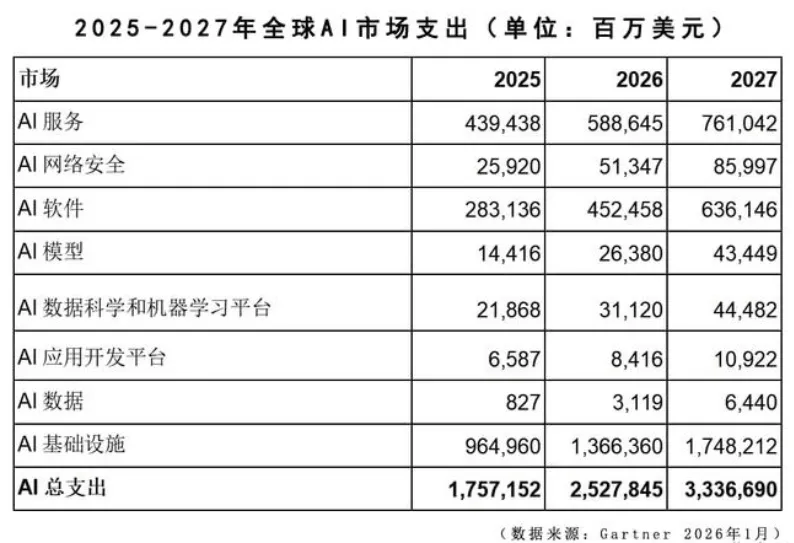
According to Gartner’s authoritative forecast, total global artificial intelligence spending will reach US$2.52 trillion in 2026, a year-on-year increase of 44%. This market atmosphere provides better market acceptance and pricing basis for AI companies to go public.
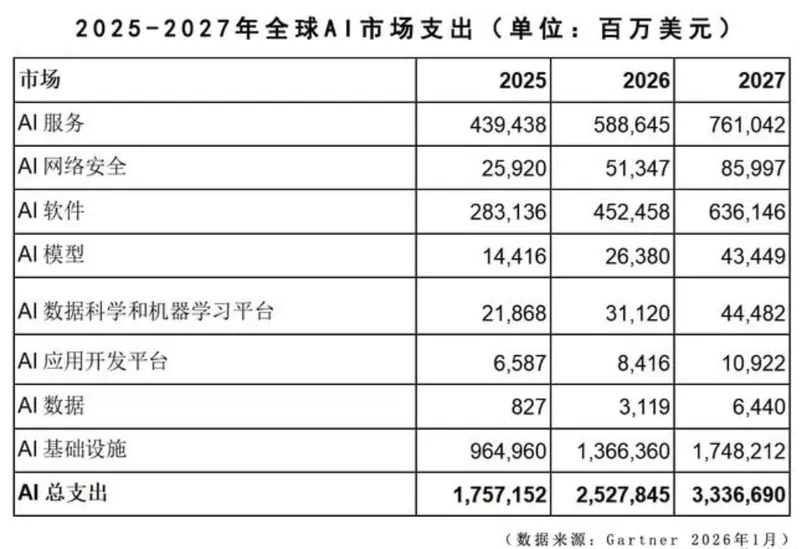
(Table: Global AI market expenditure from 2025 to 2027)
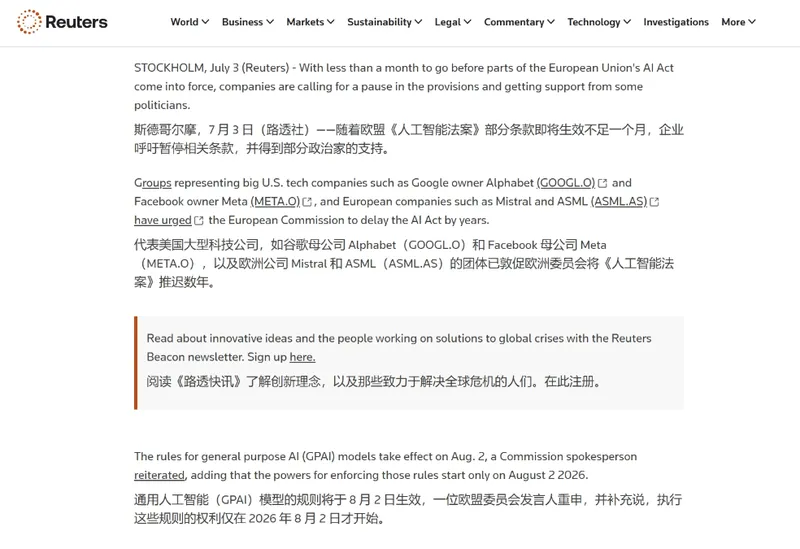
Regulation and geopolitics are becoming stricter, and the uncertainty of AI security, data compliance, export controls, and computing power supply chains have become discount items that cannot be ignored in the valuation system. For companies, the earlier they complete listing at a stage where the rules are relatively clear, the better chance they have of gaining recognition from the capital market with higher certainty.
The competitive landscape of the global AI industry has evolved from competition in model parameter scale to a trinity competition of “computing power + data + ecology”.
Huge amounts of capital expenditures (expected to jump from US$350 billion in 2025 to US$500 billion in 2026) are building a solid market foundation. Leading AI companies that can survive the fierce inference cost war and establish a solid enterprise-level customer base already have the strength and demand to impact the public market.
OpenAI
OpenAI’s IPO is one of the most watched events in global capital markets in 2026.
From a financial perspective, OpenAI’s valuation logic has shifted from the early “technology premium” to the “platform premium”. Despite the staggering computing power expenditure (2025: computing power 1.9 GW, ARR more than 20 billion US dollars), with ChatGPT’s huge subscriber base and the deep penetration of the API business on the enterprise side, the revenue growth curve shows a nearly vertical trend.
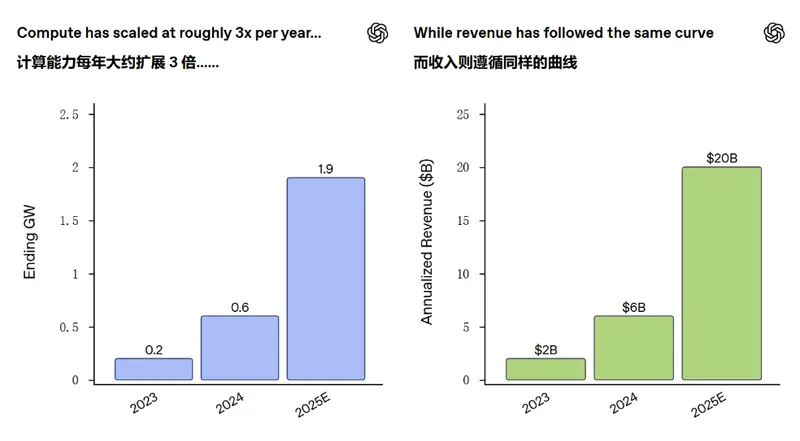
OpenAI 2023-2025 Computing Power Expenditure and Revenue
Regarding the pace of listing, the company has not yet given a clear timetable. Reuters quoted people familiar with the matter as saying that OpenAI is preparing for a potential IPO and is considering submitting an application to securities regulators as early as possible in the second half of 2026. The valuation target may be as high as US$1 trillion, and it plans to raise at least US$60 billion.
If OpenAI can be successfully listed in 2026, it will become one of the largest technology IPOs in history.
The funds raised will be used to support the infrastructure investment required for larger AI model training in the future (such as AI optimization servers) and accelerate the commercialization process.
The challenge is:
- Matching profitability and high valuation : How to prove to the public market that a valuation of up to US$1 trillion is supported by sustainable profits;
- Regulatory and Governance Structure : Must handle the intricate distribution of interests with Microsoft, as well as the balance between pursuing profits and maintaining AI security.
- Competition heats up : Need to maintain technological leadership under fierce siege from giants such as Google, Meta, and Anthropic.
Anthropic
Anthropic focuses on “Constitutional AI” and security. It is OpenAI’s most direct competitor in the field of general large models.
Anthropic has hired top law firms to pave the way for a public listing, targeting a 2026 IPO. The pre-IPO valuation could reach $350 billion.

The goal of the listing is to strengthen the capital strength to compete with giants such as OpenAI through public market financing, bring the narrative of “responsible AI” into the mainstream investment perspective, and verify its business model.
The challenge is:
- Differentiated competition : In a large model market with homogeneous functions, how to clearly explain to investors the long-term commercial value and moat of its “safety” features;
- Huge losses and money burn rate : Like all top AI labs, Anthropic faces extremely high R&D and computing costs and needs to show the market a clear path to profitability.
SpaceX
SpaceX, founded by Elon Musk in 2002, is the world’s leading launch service provider and operates the Starlink satellite Internet constellation. Core links such as rocket recovery, satellite operations, and mission planning are highly dependent on AI algorithms.
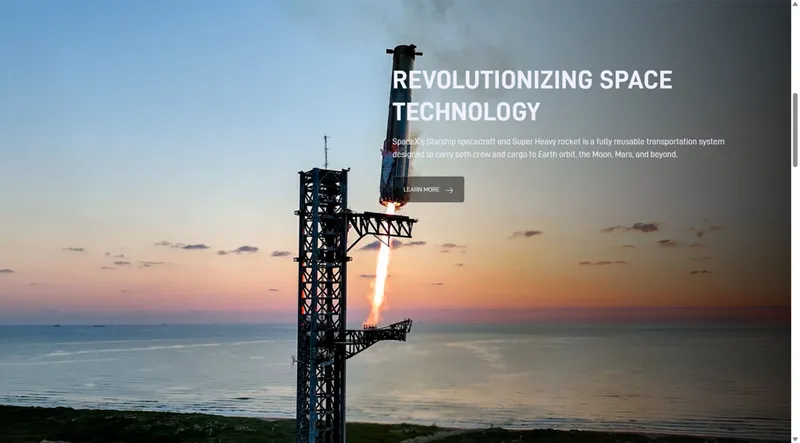
SpaceX is considering an IPO around mid-June 2026. Market predictions are that SpaceX aims to raise $50 billion at a valuation of approximately $1.5 trillion, which is expected to set a record.
If SpaceX is successfully listed, it will redefine the capital market value of “aerospace technology” and demonstrate the huge potential of AI in extremely complex physical systems.
Investors will pay more attention to Starlink’s user growth, profitability and global licensing progress, as well as the maturity of the rocket’s fully reusable technology (Starship).
The challenge is:
- business complexity : Investors need to simultaneously evaluate the value and risks of its multiple business lines such as launch services, Starlink Internet and long-term interstellar exploration;
- The “Musk Premium” and Volatility : The company’s valuation is deeply tied to Musk’s personal influence, which may bring additional emotional premiums and fluctuations;
- A bottomless pit of capital expenditures : The research and development of next-generation projects such as starships requires continuous and massive investment.
**Databricks **
Databricks is a technology company focused on the integration of data and AI. Its core product is the “Lakehouse” platform, which integrates data warehouse and AI training functions to serve enterprise-level data processing and AI model development. With more than 10,000 customers, it could be valued at $134 billion.
The business model takes the data platform as the core and achieves highly sticky customer groups by providing data processing, AI training and enterprise-level solutions.
It is necessary to pay attention to the differentiated advantages in data security and AI technology competition.
Stripe
Stripe is a payments technology company that mainly processes global electronic payments. It will handle US$1.4 trillion in transactions in 2024, and its business covers e-commerce, cryptocurrency and cross-border payments.

As a leader in financial technology, Stripe will implement automated fraud detection and complex global financial and tax management through AI in 2026, and the payment infrastructure has become fully intelligent.
With a valuation target of US$60 billion to US$90 billion, the IPO benefits from the expansion of the global payments market, but needs to deal with regulatory risks (such as antitrust scrutiny) and competitive pressure (such as PayPal, Square).
Revolut
Revolut is a British fintech company that provides digital banking, cryptocurrency and cross-border financial services with operations in more than 40 countries and a valuation of US$75 billion. The goal is to improve the accessibility of financial services through technological innovation. It will be launched in London or New York in 2026.
Canva
Canva completely subverts the creative productivity process through deep integration of generative design tools, proving that AI can significantly improve user stickiness and customer unit sales for SaaS companies.
It has more than 170 million users and a valuation of $42 billion. The IPO benefits from the growth of AI applications in the design field, but needs to deal with competitive pressure (such as Adobe, Figma) and the sustainability of user growth.

03. Potential IPO candidate companies
In addition to the giant companies in the different fields above, 2026 may also witness leading companies in different AI subdivisions entering the public market.
Potential candidate 1: xAI
Another AI company owned by Musk develops AI that understands the nature of the universe. The product Grok has been integrated into the social platform X. It represents the direction of deep integration of AI, social media and real-time data.
The biggest advantage of xAI is the synergy of the “Musk Ecosystem”, including data integration with the X platform, Tesla’s potential application scenarios, etc.
The latest news is that xAI has taken a different approach and plans to IPO through a merger with SpaceX.
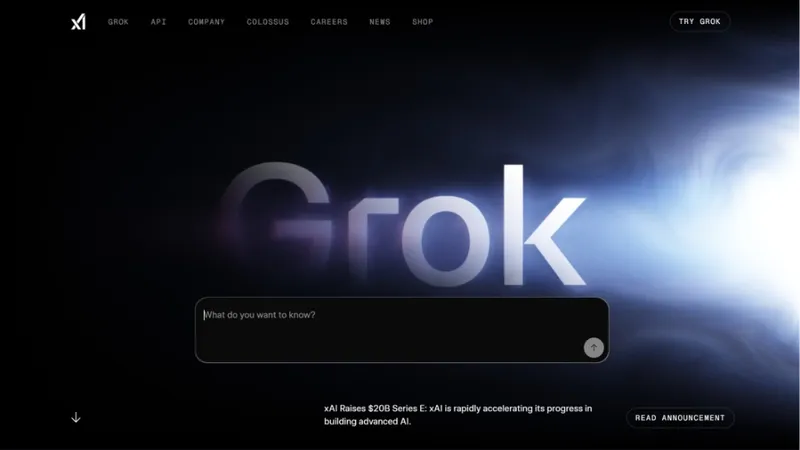
xAI’s business model is described as “exchanging capital for time” and it burns money very quickly. The main challenges of an IPO are the difficulty of valuation anchoring (lack of traditional financial indicators) and the complexity of corporate governance and control arrangements. Investors will be highly wary of Musk’s possible conflicts of interest among multiple listed companies.
Potential Candidate 2: Cerebras, Lambda Labs
Like Databricks, these companies represent key players in the AI infrastructure layer. Cerebras is a manufacturer specializing in giant AI chips; Lambda Labs provides AI computing power cloud services.
In the context of the explosive growth of AI spending, companies that serve the “shovel” and “water, electricity and coal” of AI development have strong demand for IPOs and high market acceptance. With a clearer business model and enterprise customer revenue, valuations may be relatively rational.
The challenge lies in fierce industry competition (such as against giants such as NVIDIA and AWS) and the risks of technical routes.
04. Some sharing
AI technology is evolving from single modality to cross-modal learning, and is beginning to handle more complex physical world interactions. The application scenarios and business value of AI have also broadened.
Gartner predicts that global AI market spending will reach $2.5 trillion in 2026. The market is moving from pilot projects to large-scale procurement, and budgets will be more concentrated on products and infrastructure that can truly improve efficiency and reduce costs.
The IPO boom for super assets such as SpaceX and xAI looks exciting, but the risks cannot be underestimated.
Governments will increasingly scrutinize AI monopolies, data sovereignty, and algorithmic discrimination. In the end, the capital market only recognizes one thing: whether growth can be converted into cash flow, whether reasoning costs can continue to decline, and whether corporate customers can form long-term renewals.
For investors, 2026 will be more like a reset of the pricing mechanism. The trillion-level listing wave will not only create new myths, but also accelerate the liquidation, determining which companies can continue to expand with lower-cost capital and which companies will be forced to exit due to cost wars and regulatory pressure. This is the real watershed in the landscape of technology and capital in the next ten years.
Original link: Are xAI and OpenAI going public? 2026 may be the first year of AI IPO
You May Also Like

GLM-5-Turbo - Zhipu launches a base model deeply optimized for OpenClaw
GLM-5-Turbo (codename: Pony-Alpha-2) is a foundational model launched by Zhipu AI, deeply optimized for OpenClaw (lobster) agent scenarios. From the training phase, the model undergoes specific optimizations for core capabilities such as tool invocation, complex instruction compliance, timed and continuous tasks, and high-throughput long-chain processing, addressing the challenges of general-purpose models in real-world agent scenarios.
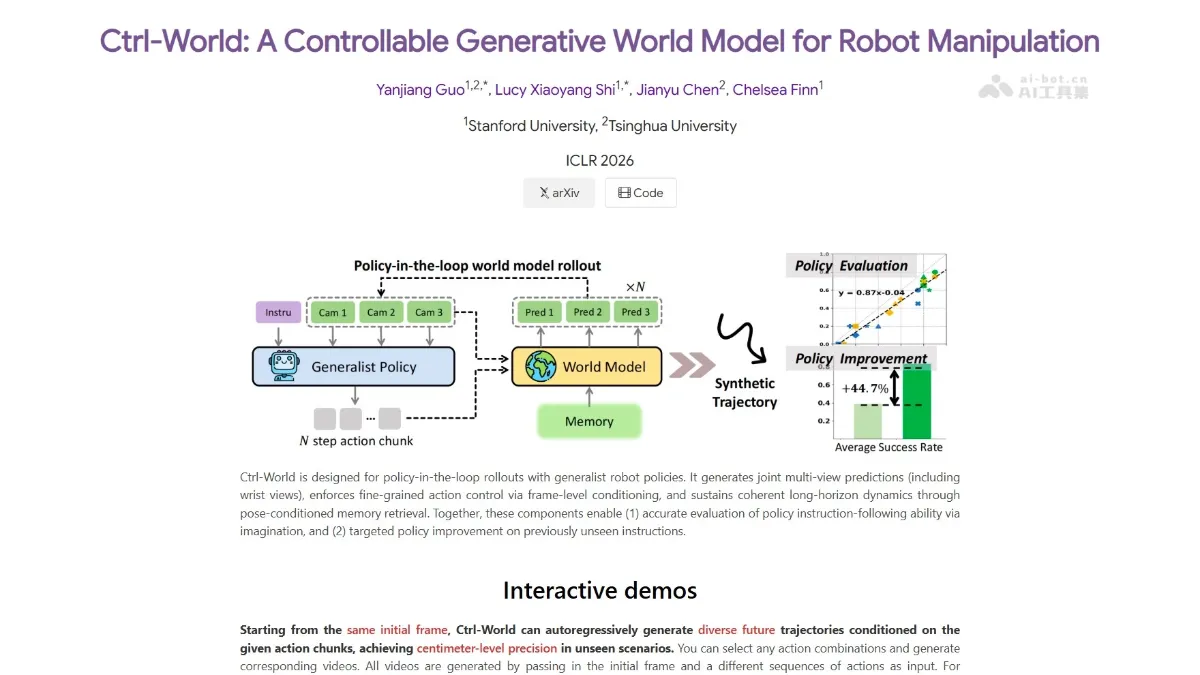
Ctrl-World - An embodied world model jointly developed by Tsinghua University and Stanford University
Ctrl-World, a embodied world model jointly developed by Chen Jianyu from Tsinghua University and Chelsea Finn`s team from Stanford University, achieved first place globally in embodied task capability and second place globally in video generation quality in the authoritative WorldArena evaluation. The model employs a motion-conditional architecture and physics engine constraints, explicitly injecting robotic arm motion parameters into the generation process, achieving centimeter-level trajectory accuracy, a policy evaluation consistency of 0.986, and a consistency of 0.93...
GLM-OCR - A lightweight multimodal OCR model from Zhipu Open Source
GLM-OCR is a lightweight multimodal OCR model open-sourced by Zhipu AI, with only 0.9B parameters in OmniDocBench...

Mureka V8 - Kunlun Tech's AI music model
Mureka V8 is an AI music model launched by Kunlun Wanwei. Based on the MusiCoT (Music Chain-of-Thought) technology architecture, it achieves a leap from sound splicing to human-like creative logic. The model has been comprehensively upgraded in four dimensions: melodic integrity, vocal expressiveness, arrangement layering, and sonic spatiality, enabling AI music to move from "generable" to "publishable." Mureka V8 has the ability to create works with complete artistic expression, aiming to provide everyone with a more immediate, personalized, and participatory music creation experience. The main functions of Mureka V8...