DeepSpeed-MII - Microsoft DeepSpeed's open-source model inference library
DeepSpeed-MII is an open-source Python library from the DeepSpeed team that provides efficient model inference. DeepSpeed-MII significantly improves inference throughput and reduces latency using innovative techniques such as blocking key-value caching, sequential batch processing, and dynamic SplitFuse, demonstrating excellent performance when handling large language models.
DeepSpeed-MII Yes DeepSpeed The team’s open source Python library provides efficient model inference. DeepSpeed-MII uses innovative methods such as blocking KV cache, continuous batch processing, and dynamic SplitFuse to significantly improve inference throughput and reduce latency, and performs well when processing large language models. DeepSpeed-MII supports a wide range of model architectures, including Llama, Falcon, and Phi-2, and is GPU accelerated through high-performance CUDA kernels. DeepSpeed-MII supports multi-GPU parallelism and RESTful API, making it easy to integrate with other systems and is an ideal choice for high-performance inference scenarios.
Main features of DeepSpeed-MII
- High performance inference optimization : Through technologies such as blocking KV cache, continuous batch processing, dynamic SplitFuse, and high-performance CUDA kernels, high-throughput and low-latency inference performance is achieved, significantly improving the inference efficiency of large-scale language models.
- Extensive model support : Supports more than 37,000 models, covering a variety of popular architectures (such as Llama, Falcon, Phi-2, etc.), and supports the integration of the Hugging Face ecosystem to facilitate users to quickly load and use pre-trained models.
- Flexible deployment methods : Provides non-persistent pipelines (suitable for quick testing) and persistent deployment (suitable for production environments), supports inference through RESTful API, and facilitates integration with other systems.
- Parallelization and scaling : Supports multi-GPU tensor parallelism and model copy, further improves throughput and availability through load balancing technology, and makes full use of hardware resources.
- Rich customization options : Users can flexibly adjust generation parameters (such as maximum length, sampling strategy, etc.) during inference, and support custom deployment names and port numbers to meet diverse business needs.
- Ease of use and integration : Quick installation through PyPI simplifies the deployment process, while seamlessly integrating with the DeepSpeed ecosystem to maintain the consistency of the technology stack.
How to use DeepSpeed-MII
- Install DeepSpeed-MII : Install via PyPI, run
pip install deepspeed-miiComplete the installation. - Non-persistent deployment : use
mii.pipeline()Create an inference pipeline and pass in the model name or path to quickly test model inference. - Persistent deployment :Pass
mii.serve()Start the persistence service, which is suitable for production environments and supports concurrent queries by multiple clients. - Multi-GPU parallelization : Settings
tensor_parallelParameters,improving inference performance with multiple GPUs. - Model copy and load balancing : Settings
replica_numparameters, start multiple model copies, and combine with load balancing to improve throughput. - Enable RESTful API :Pass
enable_restful_api=TrueEnable RESTful API to facilitate integration with other systems and support HTTP requests. - Close service : call
pipe.destroy()Close the non-persistent pipe, or useclient.terminate_server()Shut down the persistence service.
DeepSpeed-MII project address
- GitHub repository :https://github.com/deepspeedai/DeepSpeed-MII
Application scenarios of DeepSpeed-MII
- Large-scale language model inference : Efficiently handle text generation tasks for large language models such as Llama and Falcon, suitable for scenarios that require high throughput and low latency.
- Content creation and generation : Quickly generate high-quality text content in the fields of content creation, copywriting generation, and creative writing.
- Intelligent customer service and dialogue system : Provide real-time and efficient text response capabilities for intelligent customer service and chat robots to improve user experience.
- Multimodal applications : Combining multi-modal inputs such as images and voices to generate relevant text descriptions or explanations, suitable for intelligent assistants and multimedia content generation.
- Enterprise applications : Used within the enterprise for automated report generation, data analysis and interpretation, etc., to improve work efficiency and decision support.
You May Also Like
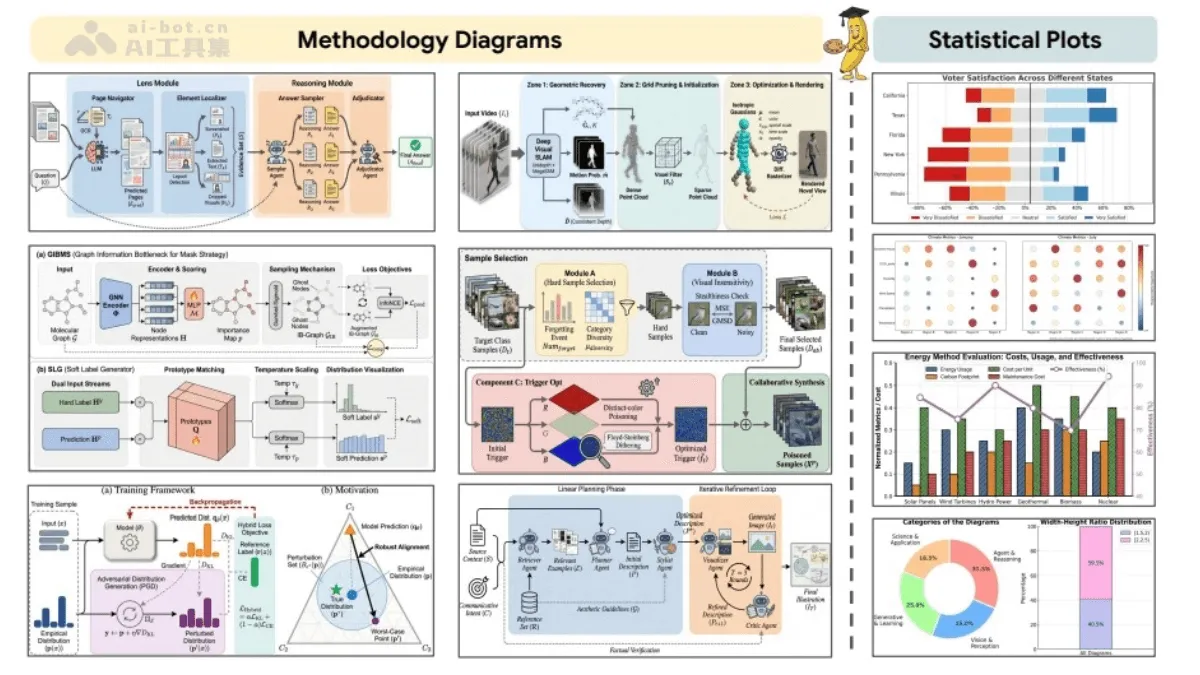
PaperBanana - An AI-powered framework for automatically generating academic illustrations, jointly developed by Peking University and Google
PaperBanana is an automated academic illustration generation framework jointly developed by Peking University and Google Cloud AI Research, addressing the pain point of time-consuming and labor-intensive data creation for AI researchers in academic papers. The system employs an innovative multi-agent collaborative architecture, comprising five specialized agents: Retriever, Planner, Stylist, Visualizer, and Critic.
NemoClaw - NVIDIA's open-source enterprise-grade AI agent framework
Homepage • AI Tools • AI Projects and Frameworks • NemoClaw - NVIDIA's Open-Source Enterprise-Grade AI Agent Framework NemoClaw is an open-source enterprise-grade AI agent framework from NVIDIA. Running as a plugin for OpenClaw, NemoClaw provides a security sandbox and policy engine through the OpenShell runtime, addressing the challenges of enterprise AI...
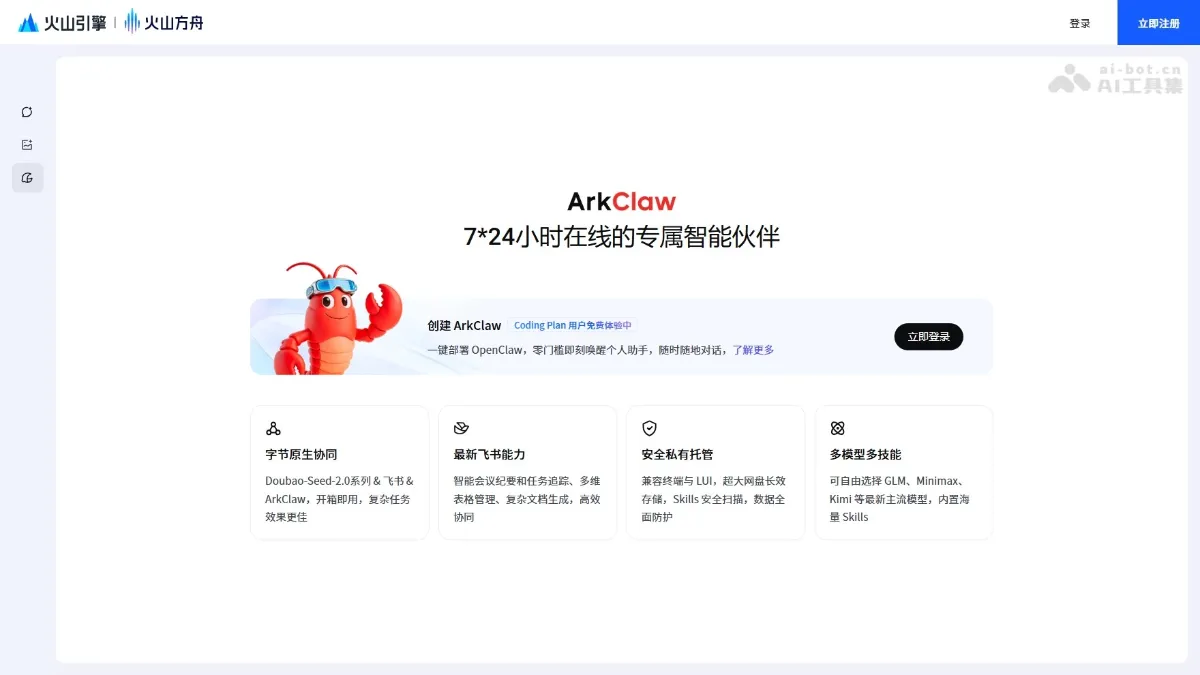
ArkClaw - A cloud-based AI assistant launched by Volcano Engine, enabling one-click deployment of OpenClaw
ArkClaw is a cloud-based AI Agent service launched by Volcano Engine, built on the OpenClaw architecture, emphasizing "out-of-the-box usability and zero-threshold shrimp farming." Users can access a 24/7 online intelligent assistant via a web browser without complex configuration. It supports mainstream models such as Doubao-Seed-2.0, Kimi, MiniMax, and GLM. Deeply integrated with Lark office suite, it can handle tasks such as scheduling, document generation, and multi-dimensional spreadsheet management. It directly connects to cloud storage for fast file transfer and includes a built-in Skills security scanning mechanism. ...

Solaris - A multi-user video world generation model open-sourced by Xie Saining's research team
Solaris is the first multiplayer video world generation model that can simultaneously generate a consistent first-person perspective for two players in Minecraft. Breaking away from the limitations of existing models that only support single-player modes, it ensures spatial consistency across player perspectives—when one player builds or moves, the other's perspective reflects the changes synchronously.