Finally, Apple supports the Claude Agent SDK!
Apple and Anthropic jointly announced early this morning that Xcode, the official programming tool for Apple platform developers, has released version 26.3, and for the first time natively integrates Claude Agent, supporting development in Agentic Coding mode. In addition to Claude Agent, Xcode 26.3 also supports integration with OpenAI's Codex code agent. ...
Apple and Anthropic jointly announced an official programming tool for Apple platform developers.Xcode Launched version 26.3 candidate and integrated natively for the first time Claude Agent, supports Agentic Coding (agent programming) approach development.
In addition to Claude Agent, Xcode 26.3 also supports access to OpenAICodexCodeAgent.
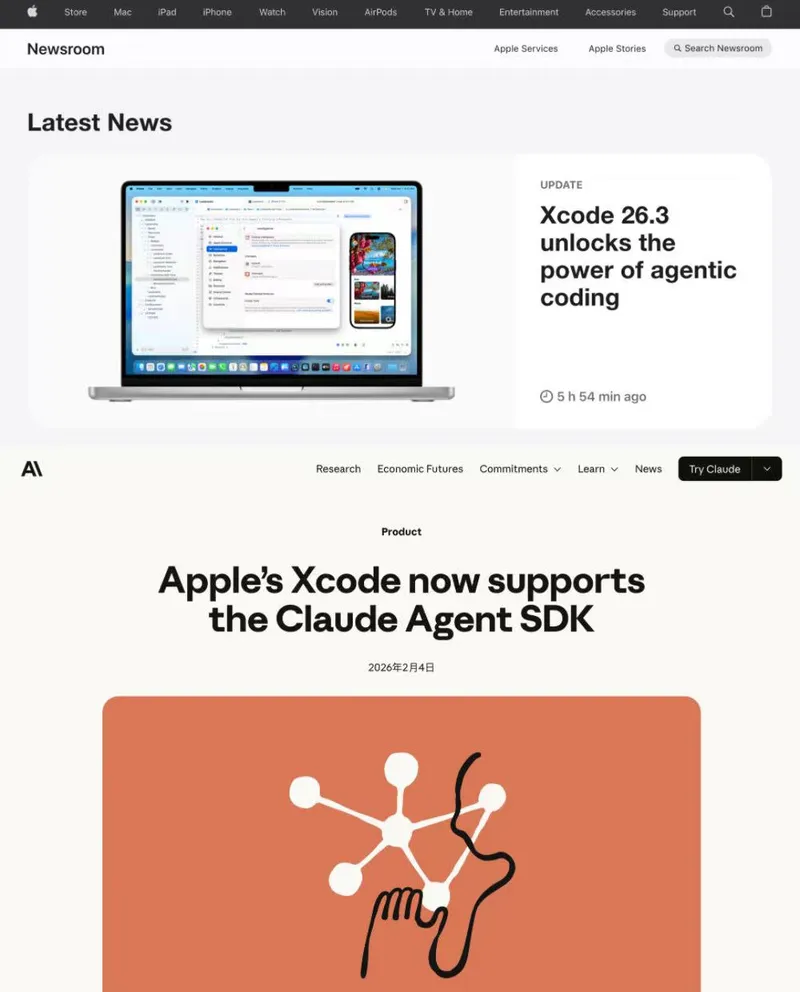
▲(Picture source: Apple official website and Anthropic official website)
In this mode, developers can directly hand over the target to the agent for execution, and the agent can independently complete open tasks such as task disassembly, code modification, interface debugging, and development document retrieval.
Compared with the code complement capabilities of ChatGPT and Claude models introduced previously in Xcode 26, this upgrade not only opens up the Native support for Claude Agent SDK, also through the Model Context Protocol (MCP) standard implementation Compatible with more Agent systems.
This will allow developers to directly call includeSub-Agents, background tasks, plug-insWait for a complete set of Agent ecological capabilities to promote the development process towards “goal-driven AI”.
Currently, all members of the Apple Developer Program can obtain the candidate version of Xcode 26.3, which will also be officially launched on the App Store soon.
1. Claude Agent and Codex are synchronously connected to Xcode
In Xcode 26.3, developers can choose to access Anthropic’s Claude Agent or OpenAI’s Codex. Both serve as the first support models for “Agentic Coding” and can deeply participate in the entire App development life cycle.
These agents can not only handle single-step requests, but also:
1.Understand the entire project structure: Automatically explore the code file system, identify architectural dependencies and contextual logic, plan first and then execute;
2.Perform complex target tasks: Developers only need to describe the goal without dismantling it step by step. Claude Agent or Codex will independently judge and modify files, search for documents, update settings and iteratively debug;
3.Conduct visual verification and iteration: Claude Agent also supports viewing the actual rendering effect of the UI through Xcode Previews and optimizing it based on the visual results, which is especially suitable for SwiftUI interface development;
4.Call native API and document search: Agent can directly access Apple development documentation and Xcode toolset, ensuring that the latest APIs are used and best practices are followed.
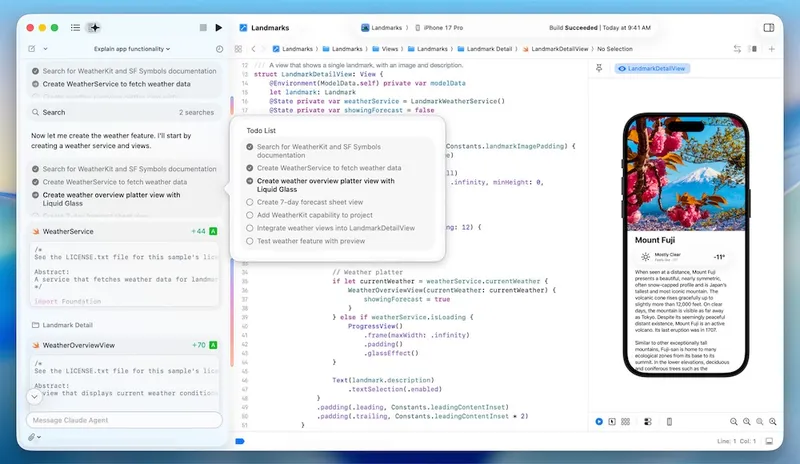
▲iPhone APP development interface (Source: Apple official website)
Throughout the process, Xcode createsEach change generates a “node” that can be rolled back, to ensure development security.
2. Agent’s “visible” interface enables autonomous AI debugging
Thanks to the deep integration of Claude Agent SDK,Xcode 26.3 opens up the ability to “visual closed loop” for the first time.
Claude Agent can intercept the real-time Xcode Previews interface, understand whether the UI design is consistent with the developer’s intention, and proactively modify the code and rebuild it based on visual feedback. This makes Claude not only “able to write”, but also “able to read”, significantly improving the quality of UI code generation in one go.
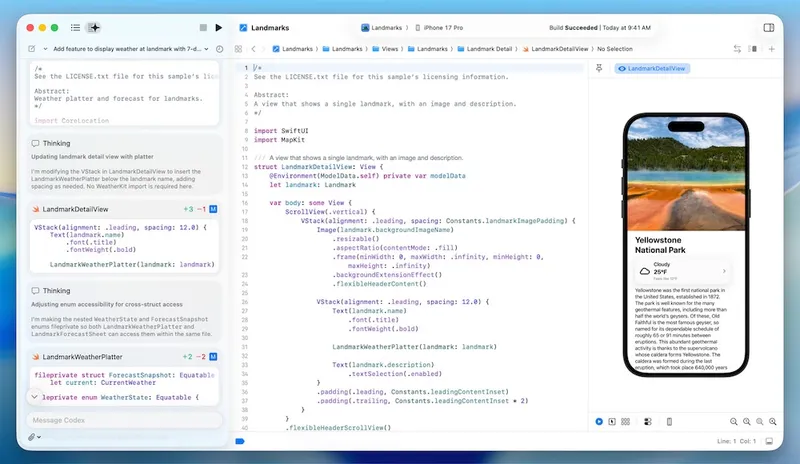
▲iPhone APP development interface (Source: Apple official website)
In addition, Xcode’s Agent system also supports “Asynchronous long-term tasks”, that is, the Agent can continue to perform target tasks in the background (such as completing complex module development, unified architecture reconstruction), and only call upon developers for confirmation or correction when necessary.
3. MCP opens up AI access standards and opens up more Agent possibilities
Another highlight of Xcode 26.3 isOfficially opened the Model Context Protocol (MCP) standard interface.
This mechanism allows developers to expose Xcode functionality toAny external agent system compatible with MCP, not limited to Claude or Codex.
Through MCP, Agent can not only realize the project Structure exploration, file reading, writing and modification, view preview and document calling, you can also interact with Xcode in the CLI (command line) environment, such as triggering interface generation or agent orchestration in a remote terminal.
This open standard will introduce a wider range of AI systems to the development ecosystem and pave the way for future capabilities such as Agent plug-in, sub-Agent collaboration, and cross-modal development.
Conclusion: Agent-based IDE is initially implemented, and Apple has taken a key step towards Agentic Coding.
Apple specifically mentioned in this update that they have worked closely with Anthropic and OpenAI to optimize Token usage and tool calling mechanisms to ensure that Agent operation efficiency and results are controllable.
Combined with its powerful IDE ecosystem and deep integration of Apple’s own hardware platforms, Xcode is becoming a cutting-edge testing ground for AI agent deployment.
Whether more agents will enter the IDE ecosystem in the future and whether a new method of “multi-agent collaborative development” will emerge is worthy of continued attention.
You May Also Like
OpenJarvis - Stanford University's open-source native AI agent framework
OpenJarvis is an open-source, local AI agent framework developed by the Scaling Intelligence Lab at Stanford University. Its core concept is to make AI execution completely localized, with cloud access as an option. The framework provides five main modules: a unified model directory layer, a hardware-aware inference engine, an agent orchestration system, tool memory, and learning optimization. It can be installed with a single click using `pip install openjarvis` and offers four interaction methods: browser, desktop application, Python SDK, and CLI.
Thinker - UBTECH's open-source embodied intelligent visual language model
Homepage • AI Tools • AI Projects and Frameworks • Thinker - UBTECH's open-source embodied intelligent visual language model...

Step 3.5 Flash - The latest open-source pedestal model from Step Star
Step 3.5 Flash is StepStar's latest open-source foundation model, specifically designed for Agent scenarios. The model employs a sparse MoE architecture with a total of 196 billion parameters, activating only 11 billion parameters per token, balancing performance and efficiency. Step 3.5 Flash boasts an inference speed of up to 350 TPS, supports 256K long contexts, and rivals top-tier closed-source models in mathematical inference, code generation (SWE-bench 74.4%), and Agent tasks. Step 3.5 Flash is open-source and supports...
GPT-5.4 nano - A lightweight, fast AI model from OpenAI
GPT-5.4 nano is the lightest and fastest version of GPT-5.4 released by OpenAI, designed for simple, high-throughput tasks with extremely high speed and cost requirements. The model performs exceptionally well in classification, data extraction, ranking, and lightweight sub-agent tasks, with an input cost of only $0.20/million tokens and an output cost of $1.25/million tokens, approximately 1/12th the cost of GPT-5.4. Currently, it is only available through an API. The main features of GPT-5.4 nano...