Gemini 3.1 Flash-Lite - Google's Lightweight Flagship Model
The Gemini 3.1 Flash-Lite is Google's lightweight flagship model, emphasizing extreme cost-effectiveness. With an output speed of 363 tokens per second and an input price of $0.25 per million tokens, it outperforms the GPT-5 mini by 5 times in speed, and costs a quarter of the price of the Claude 4.5 Haiku.
Gemini 3.1 Flash-Lite is a lightweight flagship model launched by Google, focusing on the ultimate price/performance ratio. With an output speed of 363 tokens per second and an input price of US$0.25/million tokens, the model beats the competition in terms of speed. GPT-5 mini(5 times faster), the price is Claude 4.5 Haikuof a quarter. The model surpassed many larger models in inference and multi-modal benchmark tests such as GPQA Diamond and MMMU-Pro, with an Elo score of 1432, which is the same as o3. Gemini 3.1 Flash-Lite supports adjustable depth of thinking and is suitable for scenarios such as high-frequency translation, content review, and real-time UI generation. It has currently passed Google AI Studioand Vertex AI open preview.
Main features of Gemini 3.1 Flash-Lite
- Text generation and understanding : Supports high-quality article writing, abstract extraction, question and answer dialogue and complex instruction following, with extremely fast response speed.
- multimodal processing : The model can understand and process text, images, videos, audio and PDF documents at the same time, realizing cross-modal information conversion and analysis.
- Code generation and assistance : Code can be generated based on natural language description, supports multiple programming languages, and helps developers quickly build application prototypes.
- Real-time UI and data visualization : Instantly generate user interface prototypes and dynamic data dashboards based on demand, significantly reducing front-end development costs.
- Adjustable reasoning depth : Provides multi-level thinking mode, developers can flexibly choose shallow quick response or deep reasoning analysis according to the complexity of the task.
Technical principles of Gemini 3.1 Flash-Lite
- sparse hybrid expert architecture : Gemini 3.1 Flash-Lite uses a sparse hybrid expert architecture to achieve efficient inference by dynamically activating some parameters, significantly reducing computing costs while ensuring performance.
- Attention mechanism optimization : The model is optimized for high-throughput scenarios and uses advanced attention mechanism optimization technology to reduce the memory usage of long sequence processing, thereby achieving a generation speed of hundreds of tokens per second.
- Unified multimodal coding : Multi-modal capabilities originate from the unified encoder design, which can map different modal data such as text, images, and videos to the same semantic space for joint understanding.
- adaptive calculation mechanism : The model introduces an adaptive computing mechanism to dynamically allocate reasoning resources according to task difficulty, quickly output on simple tasks, and enable deep thinking chains on complex tasks to achieve a balance between efficiency and quality.
Gemini 3.1 Flash-Lite project address
- Project official website :https://blog.google/innovation-and-ai/models-and-research/gemini-models/gemini-3-1-flash-lite/
Product Pricing for Gemini 3.1 Flash-Lite
- input :$0.25 / million tokens
- output :$1.50 / million tokens
Gemini 3.1 Flash-Lite application scenarios
- High frequency content processing : Suitable for scenarios such as large-scale text translation, content review and data classification, processing massive requests with extremely low cost and millisecond response, and supporting the content management pipeline of e-commerce platforms and social media.
- real-time interactive applications : Powering chatbots, intelligent customer service and real-time recommendation systems, with an output speed of 363 tokens/s to achieve near-instantaneous user feedback and create a smooth conversation experience.
- Multimodal content transformation : It can quickly convert unstructured content such as PDF, images, videos, and audios into structured Markdown format, which is widely used in document digitization, media asset management, and knowledge base construction.
- Intelligent interface generation : Developers only need natural language descriptions to generate complete e-commerce page prototypes, data visualization boards or management backend interfaces in seconds, significantly lowering the threshold for front-end development. ©
You May Also Like
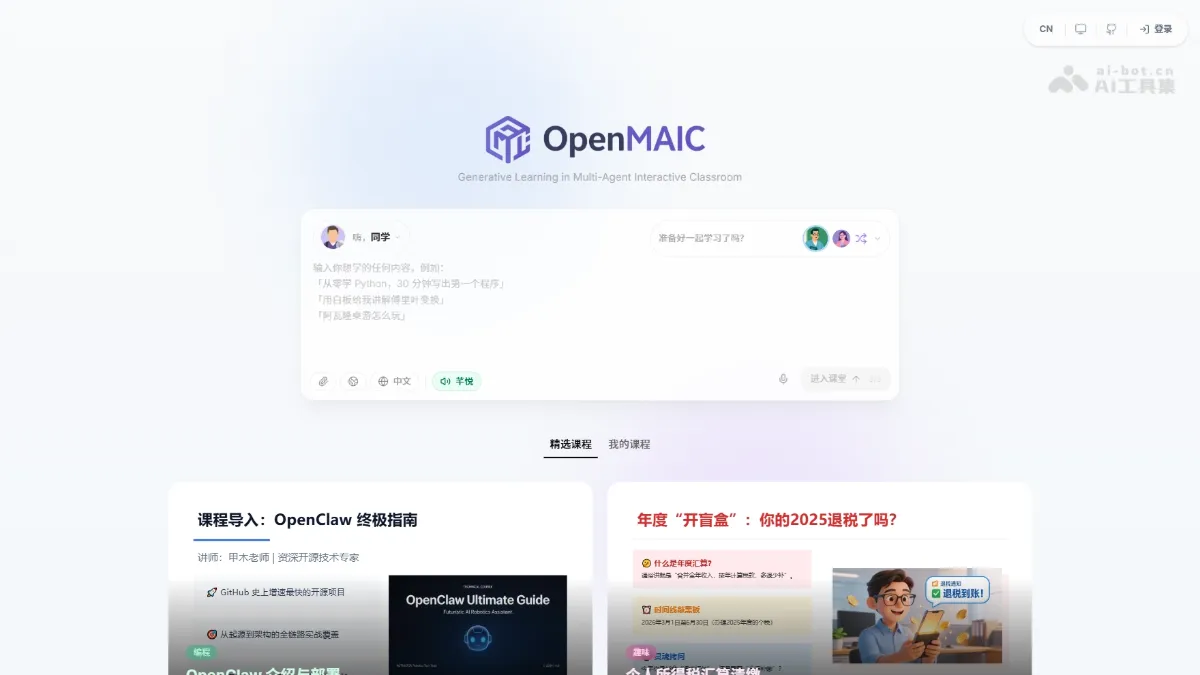
OpenMAIC - Tsinghua University's open-source multi-agent AI classroom platform
OpenMAIC is an open-source multi-agent AI classroom platform developed by a Tsinghua University team. It can transform any topic or document into an immersive interactive course with a single click. The platform supports AI teachers giving voice lectures, AI students raising their hands to discuss, and real-time drawing on the whiteboard. It can generate various teaching scenarios such as slides, quizzes, interactive simulations, and project-based learning.
OpenJarvis - Stanford University's open-source native AI agent framework
OpenJarvis is an open-source, local AI agent framework developed by the Scaling Intelligence Lab at Stanford University. Its core concept is to make AI execution completely localized, with cloud access as an option. The framework provides five main modules: a unified model directory layer, a hardware-aware inference engine, an agent orchestration system, tool memory, and learning optimization. It can be installed with a single click using `pip install openjarvis` and offers four interaction methods: browser, desktop application, Python SDK, and CLI.

EvoMap - The first open-source network protocol for experience sharing in AI agents
EvoMap is the world's first experience-based genetic network protocol for AI agents. Through the Genome Evolution Protocol (GEP), it enables AI agent capabilities to be inherited, shared, and evolved across individuals, much like biological genes. Developers can encapsulate effective strategies accumulated by the agent in tasks into...
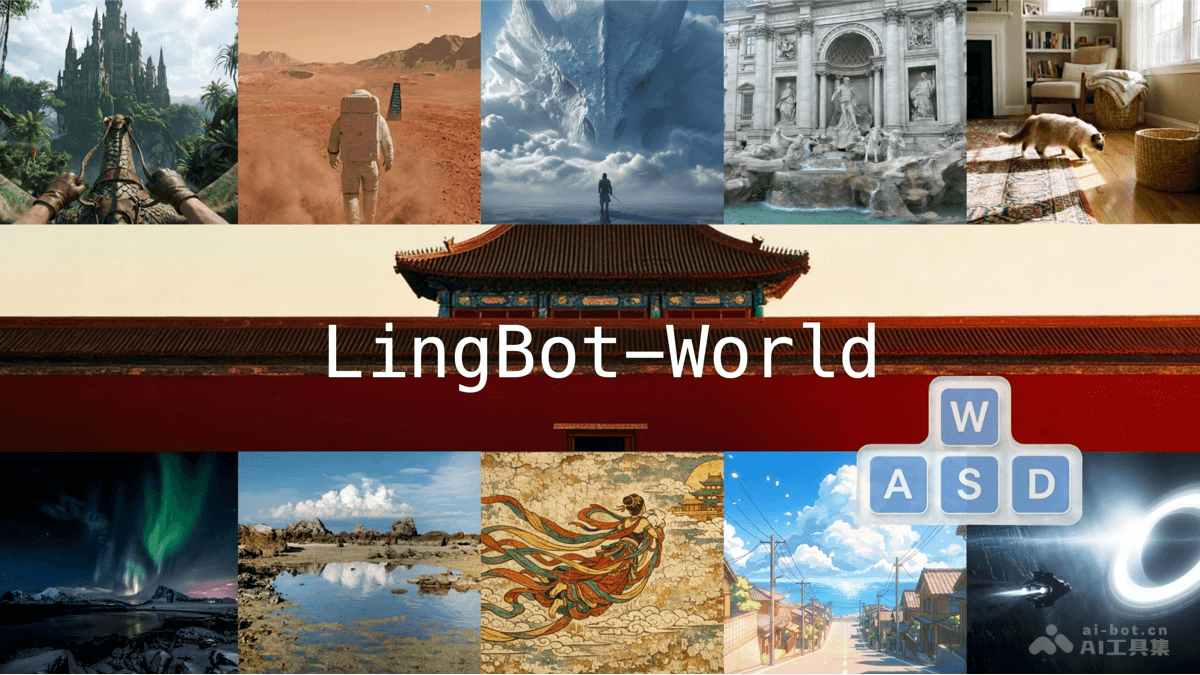
LingBot-World - An open-source interactive world model from Ant Lingbo Technology
LingBot-World is an open-source interactive world model from AntLingbo Technology. The model learns physical laws and causal relationships from large-scale game environments through a scalable data engine, achieving accurate action-driven generation. The model supports nearly 10 minutes of continuous and stable generation, with a response speed of 16 FPS and latency controlled within 1 second, while also possessing zero-shot scene generalization capabilities. The model effectively solves the pain points of scarce and costly real-world training data, and can be widely used in robot training, autonomous driving simulation, and game development, allowing intelligent agents to learn safely and efficiently through trial and error in virtual environments.