Gemini Embedding 2 - Google's first native multimodal embedding model
Gemini Embedding 2 is Google's first native multimodal embedding model, built on the Gemini architecture. The model maps text, images, videos, audio, and documents to a unified vector space, supporting semantic understanding across more than 100 languages. It can handle interleaved multimodal inputs (such as text-image combinations), embedding directly without audio transcription, and employs nested representation learning techniques for flexible dimensionality reduction. Gemini Embedding 2 boasts leading performance in tasks such as RAG and semantic search, and is now available through the Gemini API and Vertex...
Gemini Embedding 2 is Google’s first native multi-modal embedding model, built on the Gemini architecture. The model uniformly maps text, images, videos, audio, and documents into the same vector space, supporting semantic understanding across more than 100 languages. The model can handle interleaved multi-modal inputs (picture and text combinations), can be directly embedded without audio transcription, and uses matryoshka representation learning technology to achieve flexible dimensionality reduction. Gemini Embedding 2 has leading performance in tasks such as RAG and semantic search. It is now open for preview through Gemini API and Vertex AI and is compatible with mainstream AI frameworks and vector databases.
Main features of Gemini Embedding 2
- Unified multimodal embedding : Unifiedly map five different modalities of data, including text, images, videos, audios and documents, into the same vector embedding space to achieve true cross-modal semantic understanding.
- Interleaved multimodal input : The model supports processing multiple interleaved input modal data at the same time in a single request, such as passing in images and text at the same time, accurately capturing the complex relationships between different media types.
- Native audio embedding : Gemini Embedding 2 natively supports direct embedding processing of audio data, which can generate vector representation without first converting audio to intermediate text transcription results.
- PDF document embedding : The model can be directly embedded to process PDF documents of up to 6 pages, converting complex document content into vector forms that can be used for retrieval and analysis.
- Flexible dimension adjustment : The model supports flexible output dimension adjustment. Developers can choose between 3072, 1536 or 768 dimensions according to actual needs to balance embedding quality and storage cost.
- Multilingual semantic understanding : Gemini Embedding 2 can capture semantic intent across more than 100 languages, providing a unified technical foundation for multi-modal applications in multi-language environments.
Technical principles of Gemini Embedding 2
- Based on Gemini unified architecture : Built on the Gemini architecture, it inherits leading multi-modal understanding capabilities. The architecture enables the model to process and understand different types of input data simultaneously through a unified encoder design, and the native multi-modal design ensures the semantic alignment of each modality in the shared space.
- Matryoshka Representation Learning (MRL) : The model uses Matryoshka Representation Learning (MRL) technology to realize nested storage of information by dynamically reducing dimensions. MRL supports the model to learn representations of different granularities during training, so that low-dimensional subvectors can be directly extracted from high-dimensional vectors without recalculation. The nested structure allows developers to flexibly select output dimensions according to application scenarios, significantly reducing storage and computing overhead while maintaining high semantic quality.
- Unifying cross-modal semantic space : The core breakthrough of Gemini Embedding 2 is to establish a unified cross-modal semantic space. Through large-scale multi-modal comparative learning, the model learns to map content with similar semantics but different modalities to adjacent vector areas. The unified space makes cross-modal retrieval possible, such as using text descriptions to search for related images, or using images to query similar video clips, breaking the limitation of traditional single-modal embedding models that cannot directly compare different media types.
Gemini Embedding 2 project address
- Project official website :https://blog.google/innovation-and-ai/models-and-research/gemini-models/gemini-embedding-2/
Application scenarios of Gemini Embedding 2
- Retrieval Augmented Generation (RAG) : In the RAG system, Gemini Embedding 2 can simultaneously process knowledge base content in multiple formats such as documents, images, and audio, providing richer and more accurate contextual information for large language models, significantly improving the quality and relevance of generated answers.
- Legal and compliance areas : Legal professionals can use the model to quickly locate key information in the litigation evidence discovery stage, achieve high-precision retrieval of text, image and video materials across millions of records, and significantly shorten the review time of case materials.
- Enterprise knowledge management : Enterprises can embed scattered PDF reports, product images, training videos, and meeting recordings into the same vector space to build a comprehensive multi-modal knowledge base, allowing employees to quickly obtain the information they need through natural language queries.
- Multilingual content analysis : Media and content platforms can use models to achieve cross-language multi-modal content recommendation, sentiment analysis and trend monitoring, breaking language barriers to serve global users. ©
You May Also Like

SoulX-FlashTalk - Soul App's open-source real-time digital human generation model
SoulX-FlashTalk is the first 14-parameter real-time digital human generation model open-sourced by Soul App's AI team, achieving sub-second latency of 0.87 seconds and a high frame rate of 32fps. The model employs bidirectional streaming distillation and a multi-step self-correction mechanism to achieve stable generation for unlimited duration, full-body motion interaction, and multi-language support. It is suitable for 24/7 live streaming, virtual customer service, game NPCs, and other scenarios. The model has already entered the HuggingFace I2V trending list...
Paperclip - An open-source AI agent orchestration platform, operated by an AI company
Paperclip is an open-source AI agent orchestration platform that allows users to organize multiple AI agents (such as OpenClaw, Claude, and Cursor) into a true "cyber company." The platform provides a complete enterprise management architecture: organizational structure, goal alignment, task delegation, budget control, and governance auditing. AI can collaborate like employees: the CEO Agent sets strategy, the PM Agent breaks down requirements, the Dev Agent writes code, and the QA Agent oversees quality control. Humans act as the board of directors, approving decisions and intervening as needed to prevent...
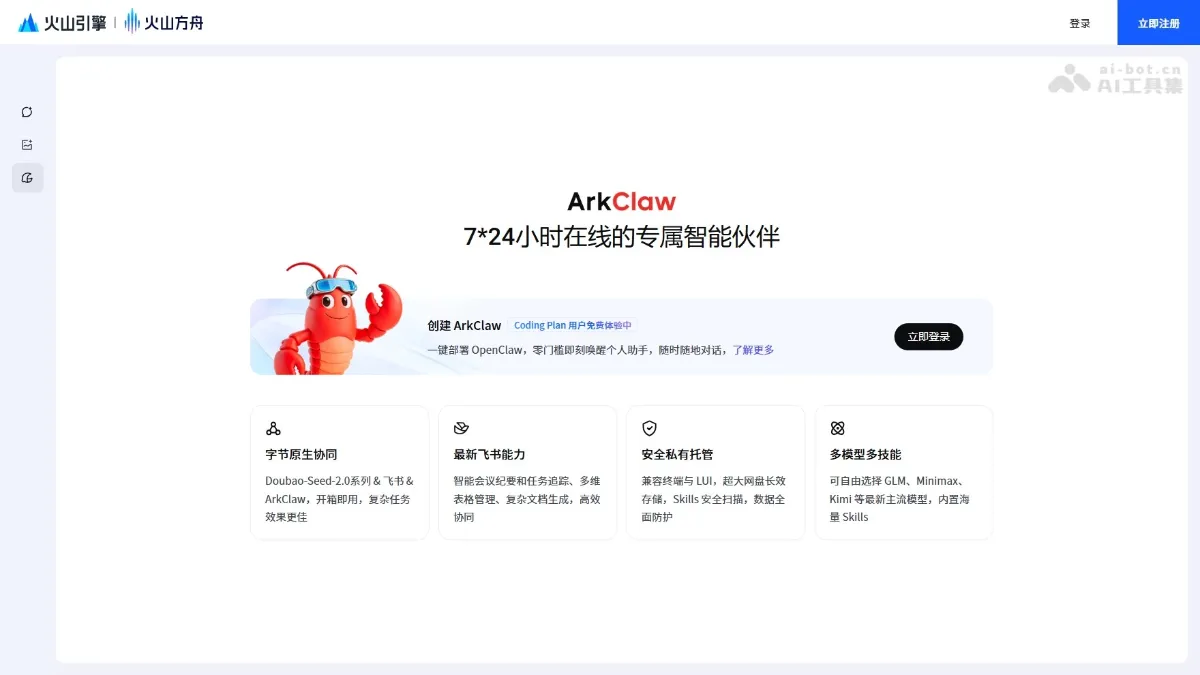
ArkClaw - A cloud-based AI assistant launched by Volcano Engine, enabling one-click deployment of OpenClaw
ArkClaw is a cloud-based AI Agent service launched by Volcano Engine, built on the OpenClaw architecture, emphasizing "out-of-the-box usability and zero-threshold shrimp farming." Users can access a 24/7 online intelligent assistant via a web browser without complex configuration. It supports mainstream models such as Doubao-Seed-2.0, Kimi, MiniMax, and GLM. Deeply integrated with Lark office suite, it can handle tasks such as scheduling, document generation, and multi-dimensional spreadsheet management. It directly connects to cloud storage for fast file transfer and includes a built-in Skills security scanning mechanism. ...
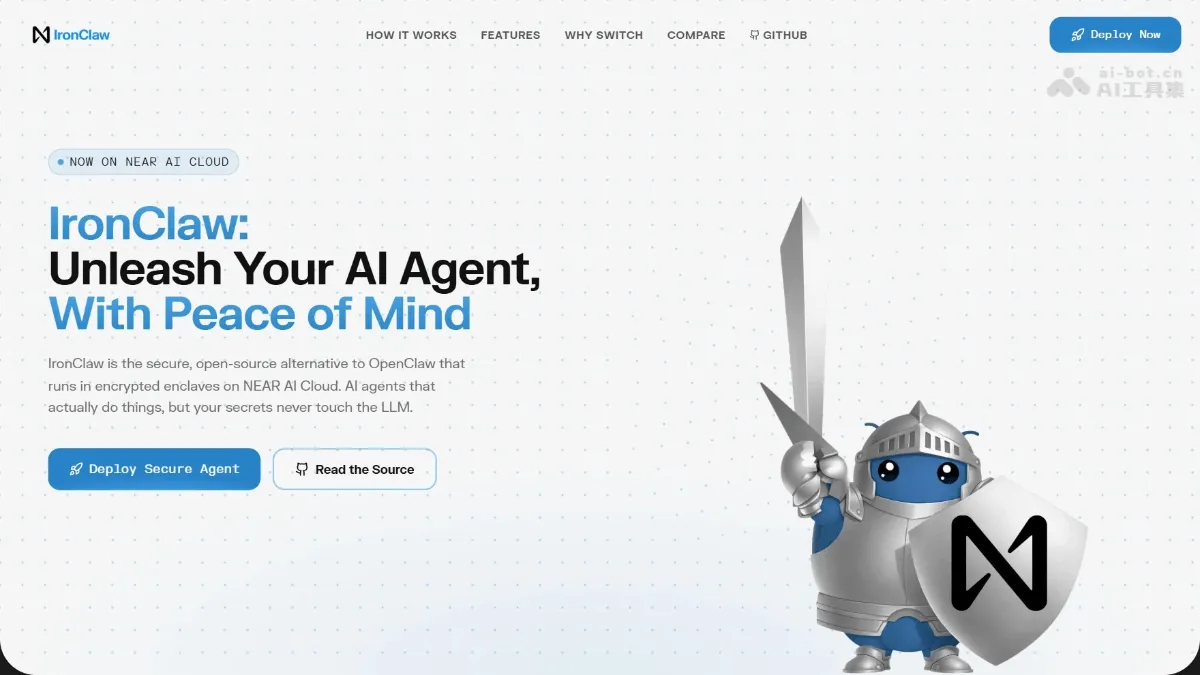
IronClaw - An open-source local security AI assistant from the NearAI team
IronClaw is an open-source AI assistant developed by the NearAI team. Implemented in Rust, it prioritizes local compatibility and security. IronClaw uses a WASM sandbox for execution and manages credentials through an encrypted vault to ensure sensitive data is never exposed to the LLM (Local Management Provider).