Goose - An open-source local AI agent framework for autonomous, complete development
Goose is an open-source local AI agent framework from Block that can autonomously execute complete engineering tasks—reading files, writing code, running tests, calling APIs, automatically debugging, and self-correcting errors until completion. The framework seamlessly integrates with tools like GitHub and Jira based on the MCP protocol and supports free switching between multiple models (Claude, GPT, Gemini, local Ollama, etc.). Goose provides desktop and CLI versions and supports...
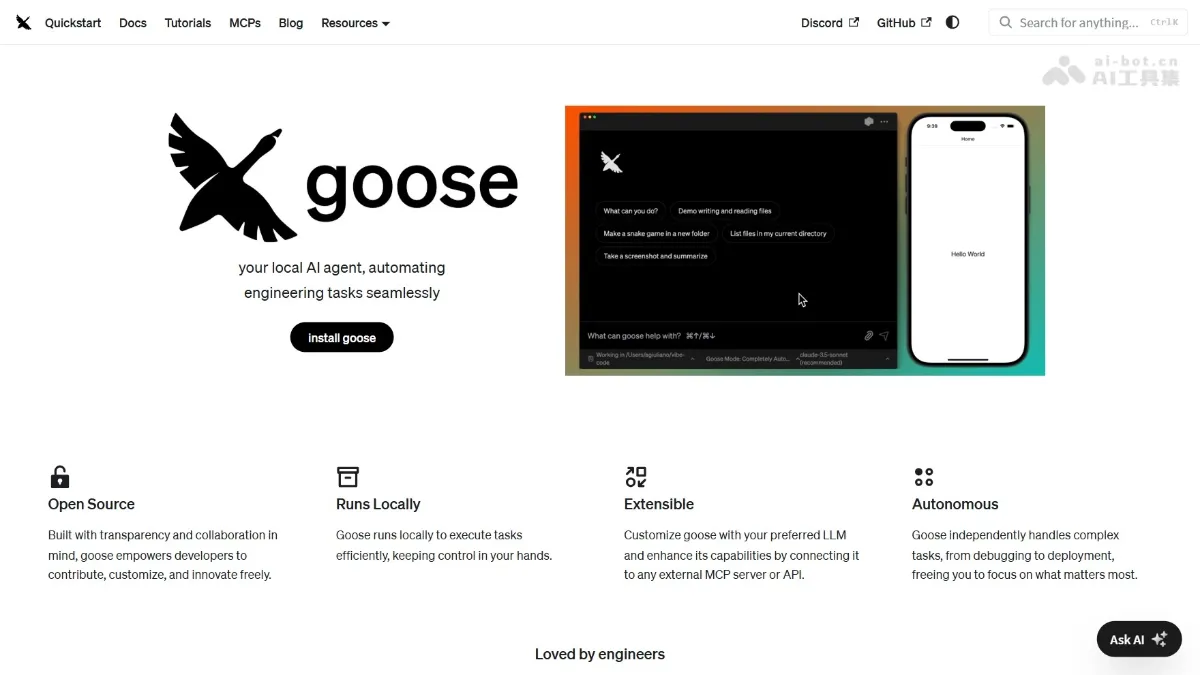
Goose is Block’s open source local AI Agent framework, which can autonomously perform complete engineering tasks - reading files, writing code, running tests, adjusting APIs, automatically debugging, and self-correcting after errors until completion. The framework seamlessly integrates GitHub, Jira and other tools based on the MCP protocol, and supports free switching of multiple models (Claude, GPT, Gemini, local Ollama, etc.). Goose provides desktop and CLI, supports macOS/Windows/Linux, and all data is processed locally to ensure privacy and security.
Goose’s main features
- Independent project execution : Goose can independently complete a complete development closed loop of reading files, writing code, running tests, executing commands, and debugging repairs. It will self-correct after errors until delivery.
- MCP tool integration : Seamlessly connect external systems such as GitHub, Jira, and databases through standardized protocols to open up the entire link from design draft to code.
- Free switching between multiple models : Not bound to a single manufacturer, supports any LLM such as Claude, GPT, Gemini, local Ollama, etc., and the cost and effect can be controlled independently.
- Double-ended use experience : Provides two forms: desktop GUI and command line CLI, covering macOS, Windows, and Linux platforms.
- Workflow automation : The built-in Recipes template reuses common tasks, and the Scheduler supports scheduled triggering to achieve true “set and forget”.
Goose’s technical principles
- MCP protocol architecture : Using Model Context Protocol as an extension standard, external tools are encapsulated as independent MCP Server, and LLM can be dynamically discovered and called through JSON-RPC communication.
- Autonomous Agent Loop : Based on the “perception-planning-execution-verification” closed-loop design, the engine parses the task intention and disassembles it into executable steps, calls the corresponding tools to complete the operation, and automatically retries or adjusts the strategy based on feedback to achieve truly autonomous decision-making.
- Multiple model abstraction layers : It shields the calling differences of different LLMs through a unified interface, supports mixed deployment of cloud API and local models, and users can switch as needed, which not only ensures data privacy but also flexibly controls costs.
- local first architecture : The core engine uses Rust to ensure performance, and the desktop is built on Tauri. All sensitive operations are completed locally, and the code never leaves the user’s machine, fundamentally solving enterprise-level security concerns.
Goose’s project address
- Project official website :https://block.github.io/goose/
- GitHub repository :https://github.com/block/goose
Goose application scenarios
- Project Initiation and Prototype Development : The framework can build a project skeleton from scratch, automatically generate directory structure, configuration files and basic code, helping developers quickly verify product ideas and enter the iteration stage.
- Code migration and refactoring : Deeply understand the legacy project architecture, independently complete complex transformation tasks such as language upgrades, framework migrations, and code specification unification, significantly reducing manual combing costs.
- Automated testing and operation and maintenance : The framework can write and execute unit tests and integration tests, automatically repair failed use cases, and supports regular inspection of system status and processing of routine operation and maintenance alarms.
- Cross-tool collaboration process : Supports reading Figma design drafts to directly generate front-end code, docking with Jira to automatically synchronize task progress, and opening up a complete link from design to development to project management. ©
You May Also Like
DeepSpeed-MII - Microsoft DeepSpeed's open-source model inference library
DeepSpeed-MII is an open-source Python library from the DeepSpeed team that provides efficient model inference. DeepSpeed-MII significantly improves inference throughput and reduces latency using innovative techniques such as blocking key-value caching, sequential batch processing, and dynamic SplitFuse, demonstrating excellent performance when handling large language models.
Fun-AudioGen-VD - A sound design model launched by Ali Tongyi Lab
Fun-AudioGen-VD is an innovative large-scale speech model launched by the speech team of Alibaba Tongyi Labs. Positioned as a professional tool for "sound design and contextualized audio generation," the model supports "FreeStyle" command generation, capable of generating high-quality audio containing specific timbre, emotional expression, and a complete auditory scene in one go based on natural language descriptions, achieving integrated sound creation of "character + scene." Regarding timbre control, Fun-AudioGen-VD...
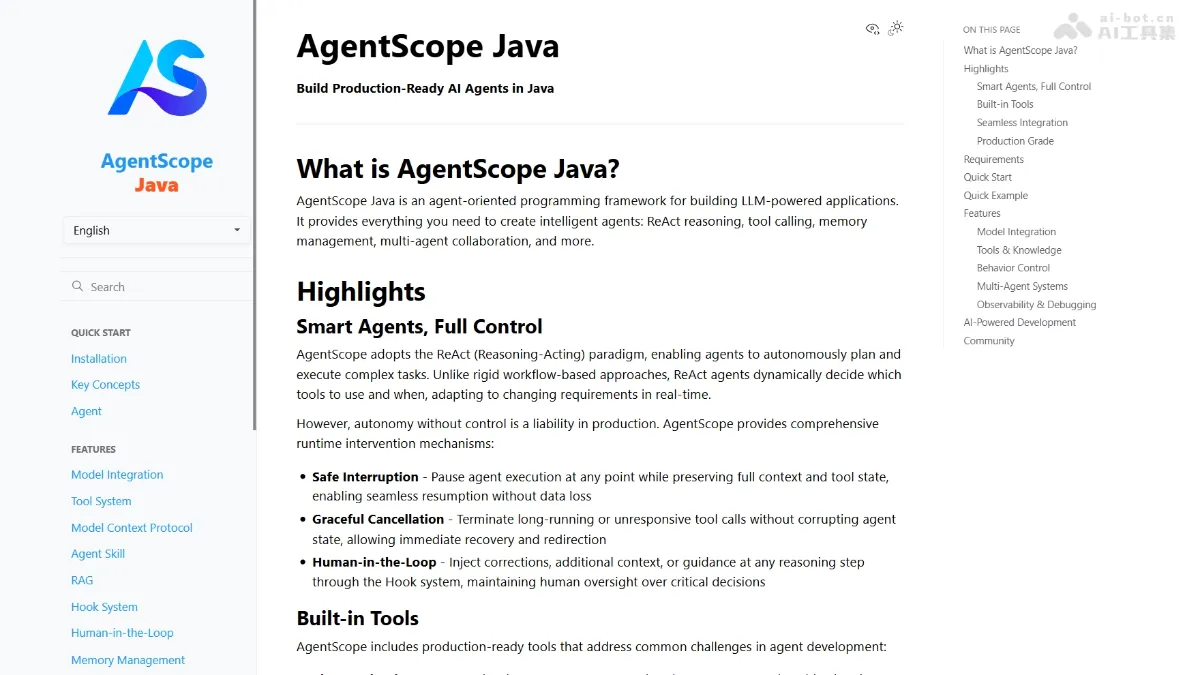
AgentScope Java - Alibaba's open-source enterprise-level intelligent agent development framework
AgentScope Java is an open-source Java framework from Alibaba for developing enterprise-level intelligent agents, enabling Java developers to easily build production-grade AI applications. The framework adopts the leading ReAct paradigm, giving large models autonomous reasoning and planning capabilities, while providing a robust runtime control mechanism to ensure a balance between autonomy and controllability.
FireRedASR2S - Xiaohongshu's open-source speech recognition model
FireRed ASR2S is a Super... on Xiaohongshu