Kairos 3.0-4B - DaXiao Robot's open-source embodied native world model
Kairos 3.0-4B is an open-source embodied native world model from DaXiao Robotics, pioneering an integrated architecture of "multimodal understanding-generation-prediction". As the world's first lightweight 4B model capable of end-device-driven robot body control, it achieves 1:1.5 real-time generation on the THOR platform, with inference speed 72 times faster than Cosmos 2.5. The model possesses extreme physical causal consistency, can generate 7-minute long, coherent interactive videos, supports cross-body generalization, allowing the same "brain" to drive multi-form robots, providing a core engine for the large-scale deployment of embodied intelligence. Kairos...

Kairos 3.0-4B is Daxiao Robot’s open source embodied native world model, the first integrated architecture of “multimodal understanding-generation-prediction”. As the world’s first 4B lightweight model that can be controlled by the end-side drive robot body, it can be generated in real time at 1:1.5 on the THOR platform, and the inference speed is 72 times higher than that of Cosmos 2.5. The model has the ultimate physical causal consistency, can generate a 7-minute long coherent interactive video, supports cross-ontology generalization, allows the same “brain” to drive multi-form robots, and provides a core engine for the large-scale implementation of embodied intelligence.
Key features of Kairos 3.0-4B
- Physical-level world understanding and generation : Accurately restore natural light and shadow, fluid dynamics, rigid body mechanics and other real physical effects. The total amount of liquid is conserved when pouring water, and the laws of gravity and support are followed when stacking stones.
- Long-term dynamic interaction : It can generate a 7-minute continuous interactive video, and combine with Agent intelligence to realize a complete home operation process such as organizing the desktop, doing laundry, and making breakfast.
- Robot body control : The model can directly output all-round control instructions from the robot’s upper limbs, fingers to lower limbs, and achieve real-time response on the end-side platform of “what you can think of and do”.
- Cross-ontology generalization : Supports multi-shaped robots such as single-arm, double-arm, and dexterous hands, and can be adapted to mainstream hardware such as Zhiyuan, Songling, and Yushu without additional training.
- Efficient data simulation : As a low-cost data simulator, it amplifies training data on a large scale and solves the industry pain point of scarcity of real machine interaction data.
Technical principles of Kairos 3.0-4B
- native embodied architecture : The model is different from the “modified” solution that adds a motion interface after the large model. Kairos is designed from the bottom of the architecture for the robot’s real-world operation. It uses the physical laws and causal laws of nature as the cognitive foundation to achieve a leap from “behavioral imitation” to “physical-level deep understanding.”
- Multimodal integration framework : Integrate the three major capabilities of “understanding - generation - prediction”, embed physical laws and causal thinking chains into the model decision-making process, be compatible with visual, text, and sensor instructions, and accurately analyze physical constraints such as force, center of gravity, and friction of objects.
- Triple data fusion : Deeply integrate the three types of data: robot real-machine interaction, human behavior structure and thought chain text, break the barriers of multiple data, and achieve strong generalization and reliable deployment under better model and data scale.
- Agent intelligence technology : Through hierarchical command analysis and structural disassembly, we can refine the prediction of space-time evolution and interaction logic, rely on the self-reflection mechanism to achieve closed-loop iterative optimization, and complete the continuous world information.
- Efficient inference operator : Self-developed mixed-time linear attention operator, with 4B lightweight parameters, achieves an inference speed 72 times faster than that of mainstream models, and is generated in real time on the client side while maintaining extremely low memory usage.
Kairos 3.0-4B project address
- GitHub repository :https://github.com/kairos-agi/kairos-sensenova
- HuggingFace model library : https://huggingface.co/kairos-agi/kairos-sensenova-common
Application scenarios of Kairos 3.0-4B
- Industrial manufacturing : Used for simulation training and trajectory planning of long-process assembly tasks, rehearsing complex operations in a virtual environment, and reducing real machine debugging costs and risks.
- home services : Drive the robot to complete daily household chores such as sorting and storage, laundry and cooking, and item delivery. The 7-minute long-term interaction capability supports continuous service scenarios.
- Logistics and warehousing : Realize dynamic planning and real-time control of tasks such as cargo handling, sorting and palletizing, and shelf inspection, and adapt to different forms of robotic arms and mobile robots.
- business services : The model can support scenarios such as tour reception, catering distribution, cleaning and maintenance, etc. The cross-ontology generalization capability allows the same system to quickly adapt to the robot hardware of different stores.
- Data collection and synthesis : As an efficient data simulator, it generates physically consistent training data at low cost and on a large scale, alleviating the bottleneck of scarcity of real machine interaction data. ©
You May Also Like
GPT-5.4 nano - A lightweight, fast AI model from OpenAI
GPT-5.4 nano is the lightest and fastest version of GPT-5.4 released by OpenAI, designed for simple, high-throughput tasks with extremely high speed and cost requirements. The model performs exceptionally well in classification, data extraction, ranking, and lightweight sub-agent tasks, with an input cost of only $0.20/million tokens and an output cost of $1.25/million tokens, approximately 1/12th the cost of GPT-5.4. Currently, it is only available through an API. The main features of GPT-5.4 nano...

Step 3.5 Flash - The latest open-source pedestal model from Step Star
Step 3.5 Flash is StepStar's latest open-source foundation model, specifically designed for Agent scenarios. The model employs a sparse MoE architecture with a total of 196 billion parameters, activating only 11 billion parameters per token, balancing performance and efficiency. Step 3.5 Flash boasts an inference speed of up to 350 TPS, supports 256K long contexts, and rivals top-tier closed-source models in mathematical inference, code generation (SWE-bench 74.4%), and Agent tasks. Step 3.5 Flash is open-source and supports...

Happy - An open-source AI programming remote control tool for real-time status monitoring
What is Happy? Happy is an open-source tool that allows users to remotely control Claude Code or Codex running on their computers via mobile phones or web clients. It supports real-time code progress monitoring, voice interaction, and push notifications, and employs end-to-end encryption to ensure data security. Users simply need to install the CLI on their computers, start the service, and scan a QR code with their mobile phones to complete pairing, achieving seamless switching across devices.
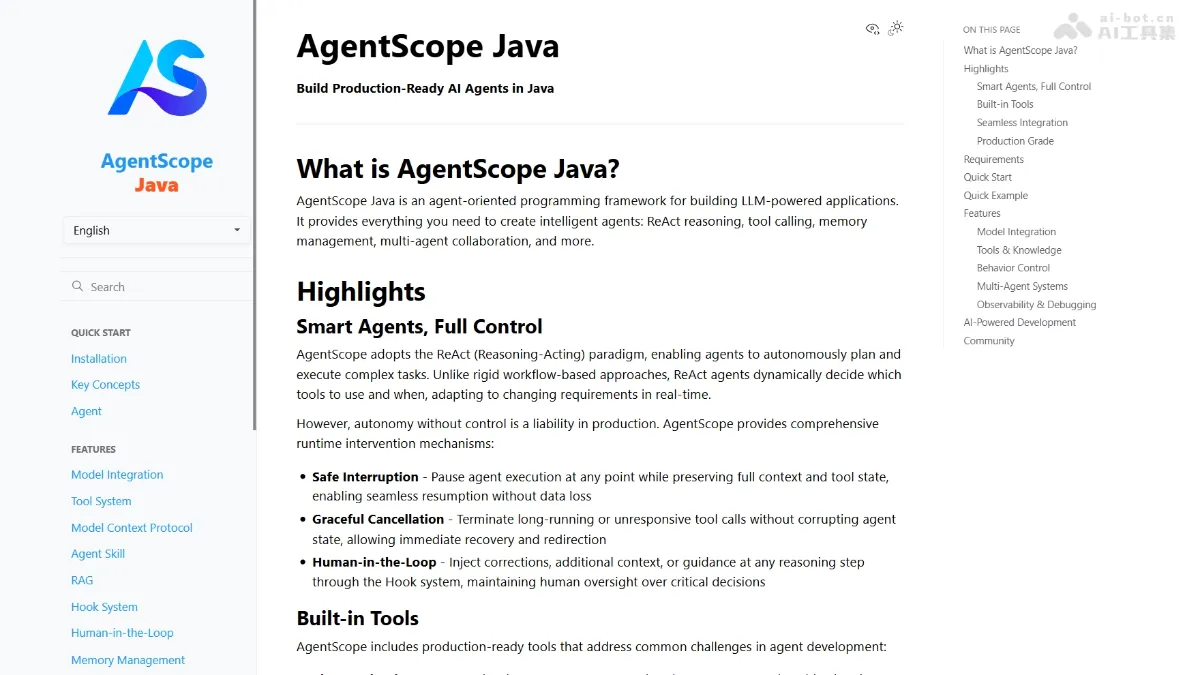
AgentScope Java - Alibaba's open-source enterprise-level intelligent agent development framework
AgentScope Java is an open-source Java framework from Alibaba for developing enterprise-level intelligent agents, enabling Java developers to easily build production-grade AI applications. The framework adopts the leading ReAct paradigm, giving large models autonomous reasoning and planning capabilities, while providing a robust runtime control mechanism to ensure a balance between autonomy and controllability.