OpenJarvis - Stanford University's open-source native AI agent framework
OpenJarvis is an open-source, local AI agent framework developed by the Scaling Intelligence Lab at Stanford University. Its core concept is to make AI execution completely localized, with cloud access as an option. The framework provides five main modules: a unified model directory layer, a hardware-aware inference engine, an agent orchestration system, tool memory, and learning optimization. It can be installed with a single click using `pip install openjarvis` and offers four interaction methods: browser, desktop application, Python SDK, and CLI.
OpenJarvis is an open source local AI agent framework launched by Stanford University’s Scaling Intelligence Lab. The core idea is to make AI execution fully localized and make cloud calls optional. The framework provides five modules: a unified model directory layer, hardware-aware inference engine, agent orchestration system, tool memory and learning optimization, and supports pip install openjarvis One-click installation, providing four interaction methods: browser, desktop application, Python SDK and CLI. The study found that the local model can handle 88.7% of single-round dialogue queries, and the intelligent efficiency increased by 5.3 times in two years. OpenJarvis evaluates energy consumption, latency, cost and accuracy simultaneously, and has built-in standardized evaluation tools. It is suitable for privacy-sensitive individual users and provides a feasible path for enterprises to reduce their dependence on cloud APIs.
Main functions of OpenJarvis
- local first architecture : AI execution runs entirely on personal devices, cloud calls are optional, and data remains local by default to protect privacy.
- Unified model management : The Intelligence module provides a local AI model directory layer to simplify model selection, compatibility, and deployment processes.
- Hardware-aware reasoning : The Engine module automatically detects hardware configuration and supports multiple inference backends such as Ollama, llama.cpp, vLLM, SGLang, etc.
- Agent orchestration system : The Agents module converts model capabilities into executable behaviors, supporting the division of roles between Orchestrator (orchestrator) and Operative (executor).
- Tools and memory connections : Connect external tools through MCP protocol and Google A2A to support semantic indexing and persistent storage of local content.
- Local learning optimization : The Learning module performs closed-loop optimization based on local interaction data, and supports fine-tuning methods such as SFT, GRPO, and DPO and automatic optimization of prompt words.
- Standardized efficiency evaluation : built-in
jarvis benchTools that evaluate energy consumption, latency, FLOPs, dollar cost, and accuracy side by side. - Multi-platform interaction : Provides four usage methods: browser application, desktop application (macOS/Windows/Linux), Python SDK and CLI.
- OpenAI compatible API :
jarvis serveStarts a service that provides a native API endpoint compatible with the OpenAI format.
Technical principles of OpenJarvis
- local first execution model : Adopting a “cloud as an option” architecture, inference is run on personal devices (laptops/workstations) by default. 88.7% of single-round conversations and inference queries do not require cloud intervention, and efficient local computing is achieved through hardware accelerators (Apple Silicon, NVIDIA GPU, etc.).
- Modular layered architecture : Loosely coupled design of five major modules - Intelligence (model abstraction layer), Engine (inference runtime), Agents (behavior orchestration), Tools & Memory (external connections), and Learning (closed-loop optimization). Each layer can be independently upgraded or replaced.
- Hardware aware scheduling mechanism : The Engine module automatically detects available hardware resources (CPU/GPU/NPU) and dynamically selects the optimal inference backend (Ollama/llama.cpp/vLLM/SGLang).
jarvis initandjarvis doctorComplete environment diagnosis and configuration recommendations. - Agent role separation : Agents adopt the Orchestrator-Operative division of labor model. Orchestrator is responsible for task planning and tool selection, and Operative focuses on executing specific actions. It supports single-agent and multi-agent collaboration modes.
- MCP/A2A protocol integration : The Tools & Memory layer connects external data sources and tools through the Model Context Protocol and Google A2A standard protocol to implement semantic indexing (vector database) and persistent memory storage of local content.
- Local continuous learning framework : The Learning module performs local model fine-tuning based on user interaction data, and supports three algorithms: SFT (supervised fine-tuning), GRPO (group relative strategy optimization), DPO (direct preference optimization), and automatic prompt word optimization (APE).
- Multi-dimensional efficiency evaluation system : Breaking through the traditional single indicator of accuracy, establishing a four-dimensional evaluation matrix of energy consumption (Watts), delay (ms), calculation amount (FLOPs), and cost ($), with built-in
jarvis benchStandardized evaluation tools enable reproducible comparisons.
OpenJarvis project address
- Github repository :https://github.com/open-jarvis/OpenJarvis
Application scenarios of OpenJarvis
- Privacy-sensitive personal assistant : Suitable for lawyers, doctors, psychological counselors and other professions that handle confidential information. All data cannot be stored locally on the cloud to avoid the risk of leakage of sensitive content.
- Intelligent office in offline environment : Business people who often travel or are in unstable network environments can continue to use AI to complete document processing, email drafting, and schedule planning in non-network scenarios such as airplanes and high-speed trains.
- Local Knowledge Base Q&A : Enterprise employees import internal documents, code libraries, and product manuals into local vector databases to build a privatized intelligent search and question and answer system to replace traditional knowledge management tools.
- Edge device AI development : IoT developers use OpenJarvis to deploy lightweight agents on edge devices such as Raspberry Pi and Jetson to realize real-time reasoning scenarios such as smart home control and industrial quality inspection.
- Low-cost AI prototyping : Start-up teams and individual developers use local models to replace cloud API calls, significantly reducing token consumption costs in the development phase and supporting smooth migration from prototype to production.
- Educational and scientific research experiment platform : University researchers leverage the framework’s built-in
jarvis benchEvaluation tools and various fine-tuning methods to carry out academic experiments such as model efficiency optimization and agent behavior research ©
You May Also Like

Unveiling the Dark Horse of Databases Valued at Hundreds of Billions: ByteDance, Alibaba, Tencent, Microsoft, and Tesla All Use It - ZhiDongXi
Zhidx.com (WeChat Official Account: zhidxcom) Author | Cheng Qian Editor | Xin Yuan Riding the wave of AI, an open-source database startup has seen its valuation increase 2.5 times in 7 months, reaching $15 billion (approximately RMB 104.5 billion). ...
FireRedASR2S - Xiaohongshu's open-source speech recognition model
FireRed ASR2S is a Super... on Xiaohongshu
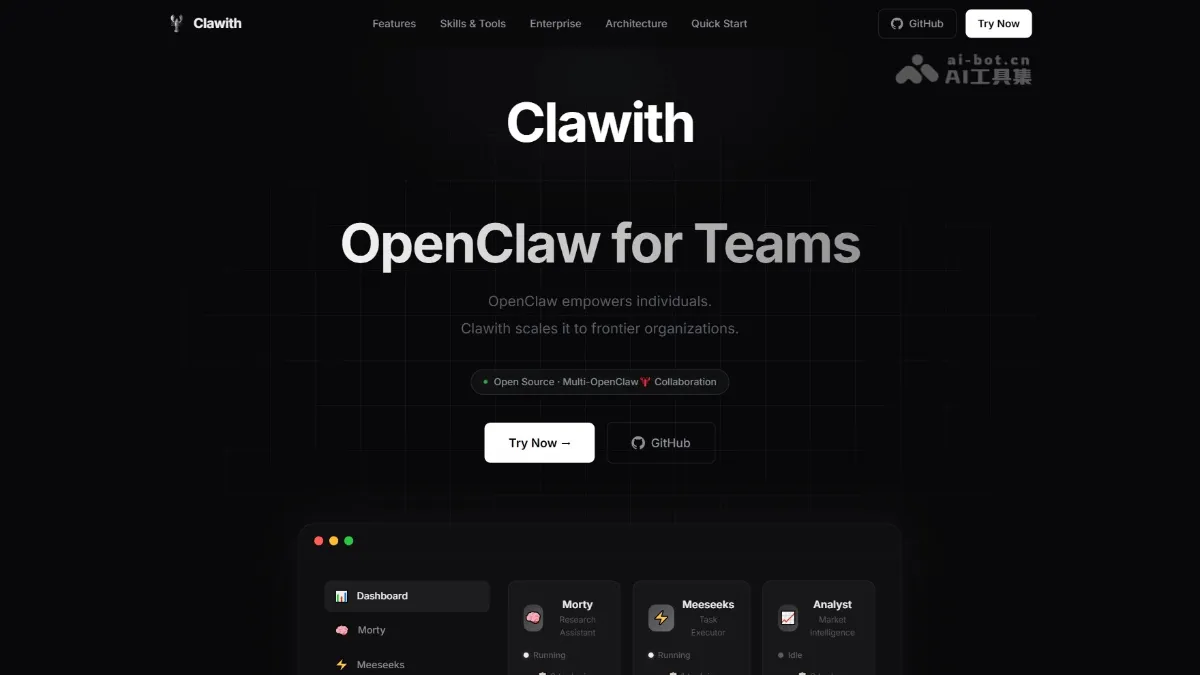
Clawith - An open-source multi-agent collaboration framework, the OpenClaw team collaboration version
Clawith is an open-source hybrid multi-agent collaboration framework for enterprises, treating AI agents as "digital employees" rather than simple chat tools. Each agent possesses a persistent identity (soul.md), long-term memory (memory.md), and an independent workspace, enabling it to understand organizational structure and collaborate with humans/other agents. Clawith supports Plaza knowledge-sharing spaces, automatic follow-up of supervised tasks, runtime tool self-discovery (MCP registry), and enterprise-level governance (auditing, quotas, approvals). Clawith is based on React...
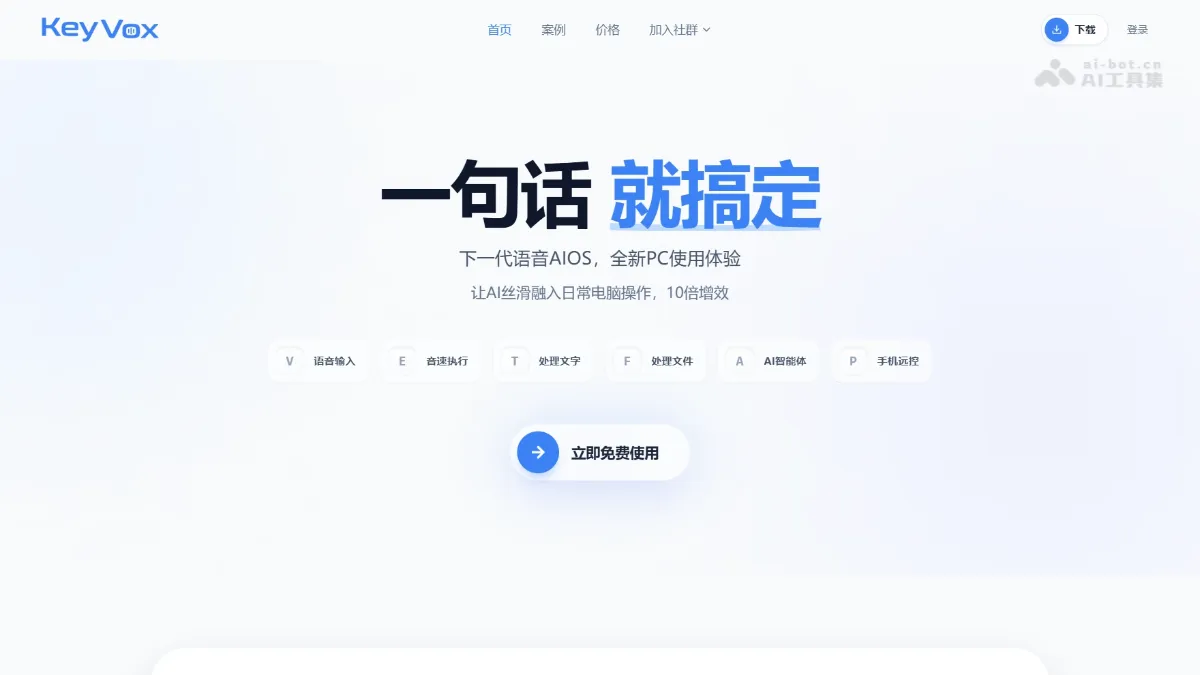
KeyVox - A PC AI voice assistant that supports remote PC control via mobile phone and WeChat
KeyVox is an AI voice assistant built on PC operating systems, supporting both Mac and Windows. This tool replaces keyboard and mouse as the primary means of computer operation with voice; simply speaking the name of an application or website will open it directly, and selecting text or files and stating your request will execute actions such as compressing images, capturing videos, converting formats, and rewriting text.