Paperclip - An open-source AI agent orchestration platform, operated by an AI company
Paperclip is an open-source AI agent orchestration platform that allows users to organize multiple AI agents (such as OpenClaw, Claude, and Cursor) into a true "cyber company." The platform provides a complete enterprise management architecture: organizational structure, goal alignment, task delegation, budget control, and governance auditing. AI can collaborate like employees: the CEO Agent sets strategy, the PM Agent breaks down requirements, the Dev Agent writes code, and the QA Agent oversees quality control. Humans act as the board of directors, approving decisions and intervening as needed to prevent...
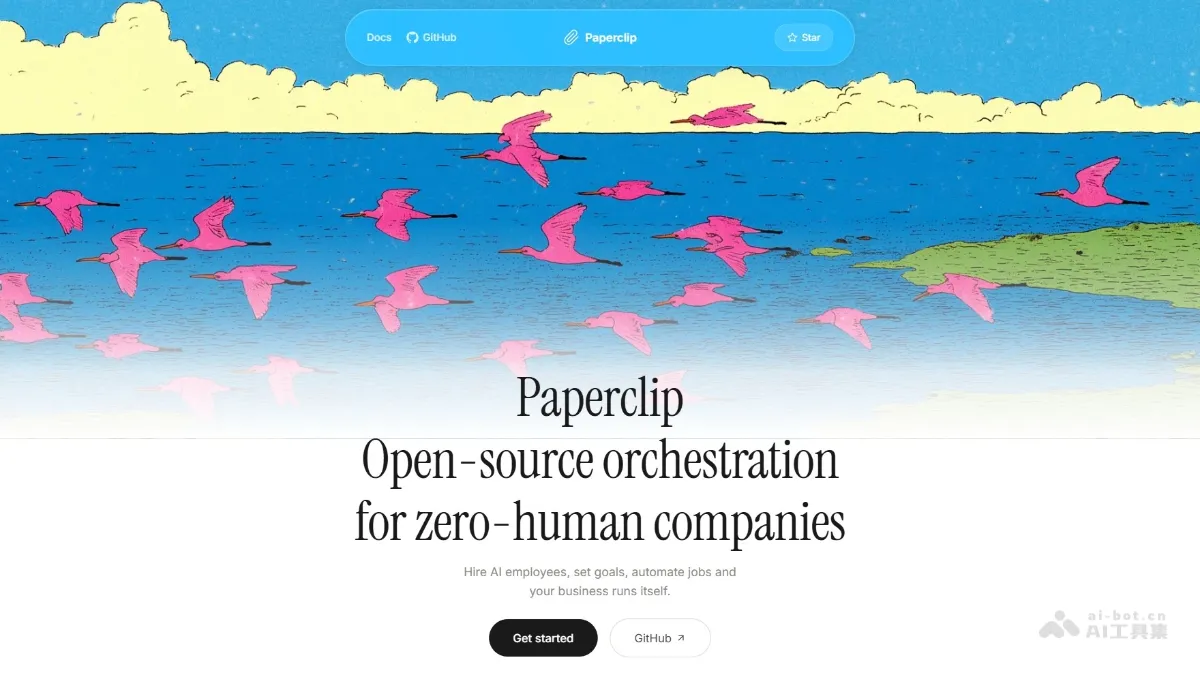
Paperclip is an open source AI Agent orchestration platform that supports users to combine multiple AI Agents (such as OpenClaw , Claude, Cursor) organized into a true “cyber company.” The platform provides a complete enterprise management structure: organizational structure, goal alignment, task delegation, budget control and governance audit. AI can collaborate like employees. The CEO Agent determines the strategy, the PM Agent breaks down the requirements, the Dev Agent writes the code, and the QA Agent checks. Humans act as the board of directors, approving decisions and intervening at any time to prevent API costs from getting out of control and completely solve the pain point of chaotic multi-agent management.
Main functions of Paperclip
- Bring Your Own Agent : Supports access to any AI Agent, including OpenClaw, Claude, Cursor, Codex, etc., as long as it can receive heartbeat signals, it can be recruited into the company.
- Organizational structure management : Provides complete org chart functions, supports setting positions, reporting lines and hierarchical relationships, allowing AI Agents to collaborate like real employees.
- target alignment system : Each task carries a complete goal hierarchy from company mission to specific execution, ensuring that the Agent knows what it is doing and why it is doing it.
- budget control mechanism : Set a monthly budget limit for each Agent, and automatically shut down the budget when it is spent to prevent API costs from getting out of control, and all costs are transparent and traceable.
- human governance intervention : Humans act as a board of directors and can approve Agent onboarding, override policy decisions, and suspend or fire underperforming Agents.
- Heartbeat scheduling execution : Agent automatically wakes up according to a preset schedule, checks task status and executes it, and supports cross-session persistence of task context.
- Audit log system : Completely records every conversation, every decision, and every tool call, providing an immutable traceability record of operations.
- Multi-company isolation support : A single deployment instance can run multiple independent companies at the same time, and the data of each company is completely isolated, making it suitable for managing business portfolios.
Technical principles of Paperclip
- Atomic execution and concurrency control : Paperclip uses atomic operations to manage task collection and budget deductions, ensuring that there will be no duplicate tasks or budget overruns in a multi-Agent concurrent environment. This mechanism is implemented through database transactions and optimistic locking to ensure the consistency of the system state.
- Persistent Agent State : Different from stateless Agent calls, Paperclip stores the Agent’s execution context persistently, so that the Agent can return to the previous task state and continue execution when each heartbeat wakes up, significantly reducing Token consumption and improving execution efficiency.
- Runtime skill injection : The system supports dynamically injecting project-specific skills and contextual knowledge into the Agent at runtime. The Agent can understand Paperclip’s workflow and project specifications without retraining. This design achieves the scalability of the Agent’s capabilities and the flexibility of project adaptation.
- Goal aware execution engine : The task object embeds complete target-level metadata, and drills down from the company’s mission to specific tasks. The Agent can obtain complete contextual semantics during execution to ensure that the behavior is consistent with the company’s strategy and avoid execution that deviates from the expected goal.
Paperclip project address
- Project official website :https://paperclip.ing/
- GitHub repository :https://github.com/paperclipai/paperclip
Application scenarios of Paperclip
- One-person enterprise automation operation : Independent developers or entrepreneurs can build a complete AI-driven company, allowing AI Agents to assume roles in product, development, operation, etc. to achieve 7×24 autonomous operation and significantly reduce labor costs.
- Multi-Agent project coordination : When using multiple AI tools such as Claude Code, OpenClaw, and Cursor at the same time, Paperclip uniformly manages their task allocation and progress synchronization, solving the problems of terminal confusion and context loss.
- AI team cost control : Set a budget cap for each AI Agent to prevent API fees from skyrocketing due to endless loops or hallucinations. It is suitable for teams that need to strictly control cloud service expenditures.
- Automated workflow hosting : Handle repetitive tasks such as customer service, content publishing, and data reporting to the AI Agent for execution as planned, and periodically wake up for processing through the heartbeat mechanism, eliminating the need for manual triggering. ©
You May Also Like
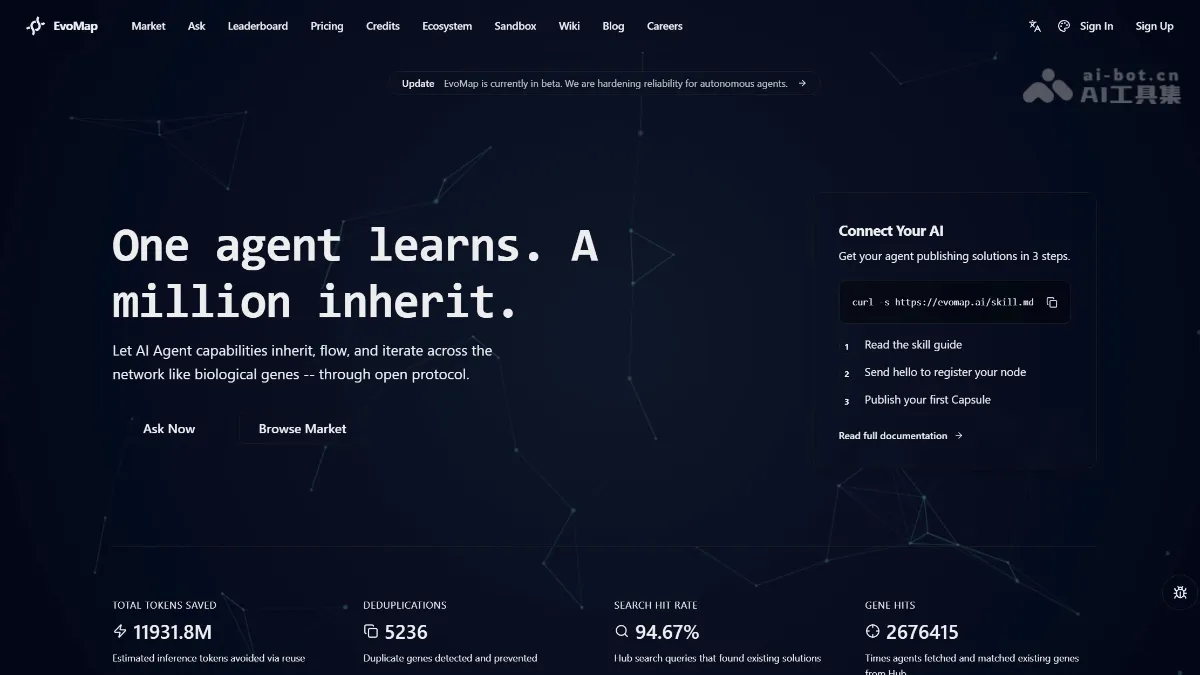
EvoMap - The first open-source network protocol for experience sharing in AI agents
EvoMap is the world's first experience-based genetic network protocol for AI agents. Through the Genome Evolution Protocol (GEP), it enables AI agent capabilities to be inherited, shared, and evolved across individuals, much like biological genes. Developers can encapsulate effective strategies accumulated by the agent in tasks into...
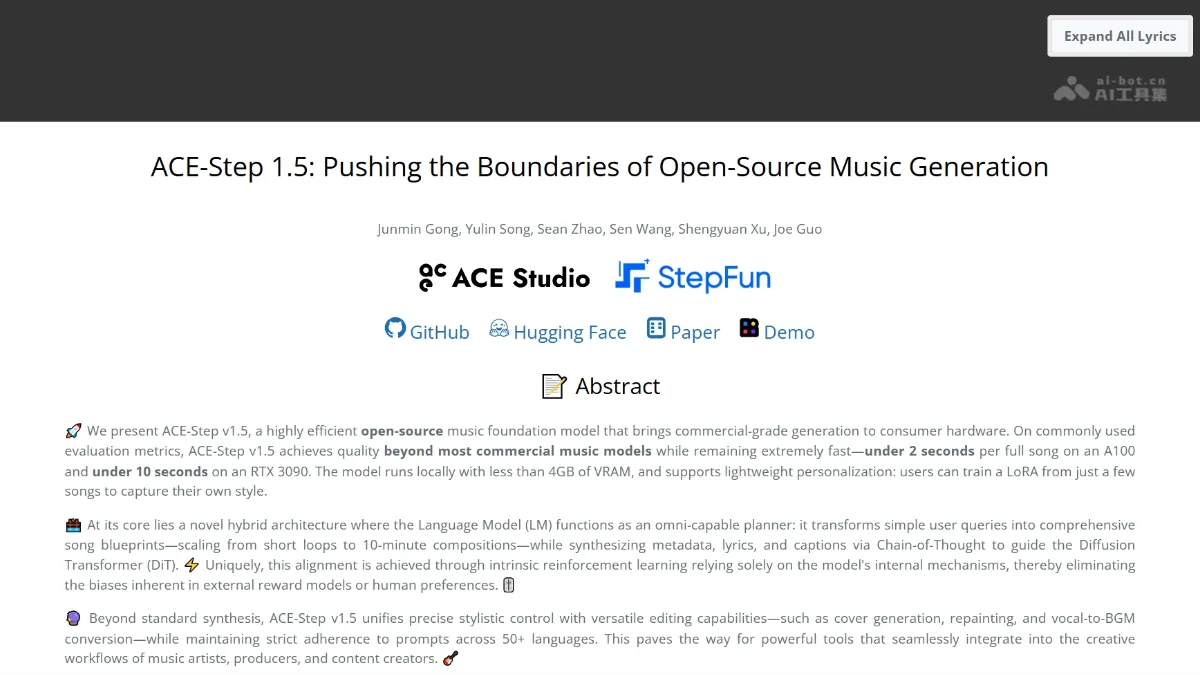
ACE-Step 1.5 - A music generation model open-sourced by ACE Studio and StepFun
ACE-Step 1.5 is an open-source music generation model jointly developed by ACE Studio and StepFun, enabling commercial-grade music generation on consumer-grade hardware. The model employs a hybrid architecture: a language model acts as a planner, transforming user prompts into song blueprints, while a Diffusion Transformer handles acoustic rendering.

Kairos 3.0-4B - DaXiao Robot's open-source embodied native world model
Kairos 3.0-4B is an open-source embodied native world model from DaXiao Robotics, pioneering an integrated architecture of "multimodal understanding-generation-prediction". As the world's first lightweight 4B model capable of end-device-driven robot body control, it achieves 1:1.5 real-time generation on the THOR platform, with inference speed 72 times faster than Cosmos 2.5. The model possesses extreme physical causal consistency, can generate 7-minute long, coherent interactive videos, supports cross-body generalization, allowing the same "brain" to drive multi-form robots, providing a core engine for the large-scale deployment of embodied intelligence. Kairos...
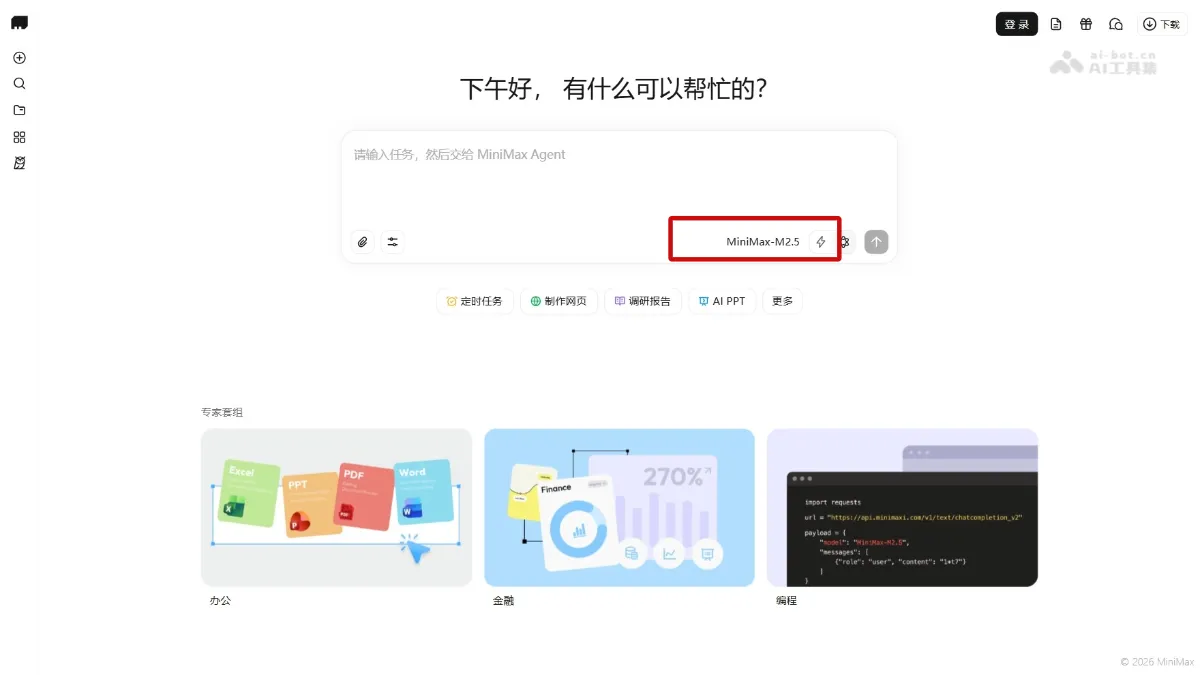
M2.5 - MiniMax's flagship programming model
M2.5 is MiniMax's lightweight flagship model with 10B activation parameters, emphasizing programming and agentic capabilities. The model supports an ultra-high inference speed of 100 TPS (approximately 3 times that of Claude Opus) and supports full-stack development, complex logic reasoning, and enterprise-level system construction in 10+ languages (Go, Rust, Kotlin, Python, Java, etc.).