Riverflow 2.0 - An image generation and editing model from Sourceful
Riverflow 2.0 is a production-grade image generation and editing model from Sourceful, designed specifically for marketing and creative teams. The model includes two versions: PRO and FAST. PRO prioritizes ultimate quality and consistency, performing best in text rendering, cue adherence, and realism; FAST is optimized for rapid iteration, offering lower latency and lower cost.
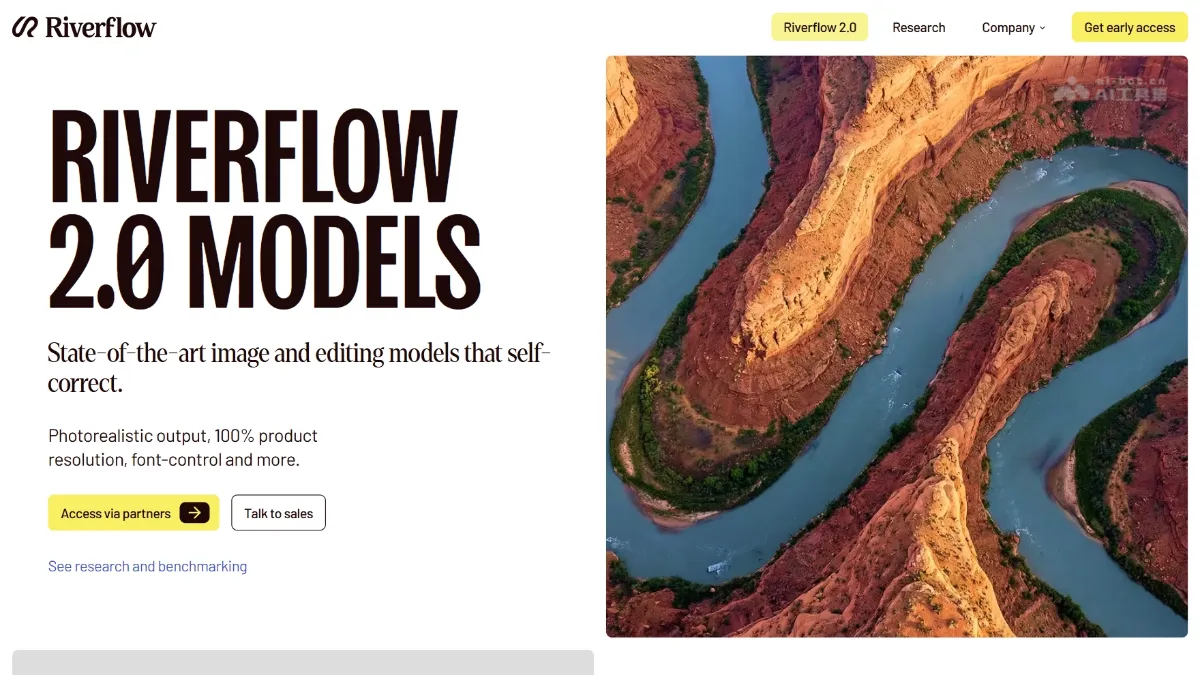
Riverflow 2.0 is the production-grade version launched by Sourceful image generationwith editorial mockups, designed for marketing and creative teams. The model includes two versions, PRO and FAST: PRO pursues ultimate quality and consistency, and has the strongest performance in text rendering, prompt following, and realism; FAST is optimized for rapid iteration, with lower latency and better cost. The model supports precise font control (up to 2 fonts, 300 characters), can identify and match brand fonts, and provides reference-based super-resolution repair to automatically identify and repair product detail issues in 2K/4K images. In the independent benchmark test Artificial Analysis, Riverflow 2.0 ranked first in both image editing and Vincent graphics.
Key features of Riverflow 2.0
- Reliability enhancement : The built-in inference model automatically reviews and generates candidate graphs for iterative correction to ensure consistent results from multiple runs and reduce effective success costs.
- Precise font control : Supports custom brand font recognition and rendering, can handle mixed layout of dual fonts and up to 300 characters, and automatically verifies typesetting details such as character spacing and stroke thickness.
- Reference driven super-resolution : Guided by high-quality reference images, it intelligently identifies and automatically repairs damaged text and product details in 2K/4K images, and supports up to 4 repairs in a single image.
- Context-aware generation : The model can understand object relationships and brand elements in complex scene descriptions, and generate advertising and product images that maintain a unified visual style and coordinated lighting.
- Dual version architecture : The PRO version focuses on ultimate quality and prompt compliance, while the FAST version optimizes reasoning speed and cost to meet the needs of different production scenarios.
Technical principles of Riverflow 2.0
- Multi-layer model collaboration architecture : Riverflow 2.0 is a layered system that integrates open source, closed source and self-developed diffusion models. The bottom layer calls various frontier diffusion models to perform basic generation tasks, and the upper layer deploys a dedicated inference model as a “reviewer” to conduct quality assessment and error identification on candidate outputs, forming a closed-loop workflow of “generation-review-correction”, which can achieve self-correction without manual intervention.
- Hype-Edit-1 Reliability Assessment Framework : The team developed the open source benchmark Hype-Edit-1. By repeatedly performing the same editing task, the stability of the model output is measured, the “effective success cost” indicator is defined, and the cost of single image request, number of retries and manual review costs are comprehensively calculated to provide a quantitative basis for production-level selection.
- Font rendering verification mechanism : To solve the problem of text generation, the system introduces a font understanding module to analyze the font files provided by users (supporting public fonts and custom brand fonts), extract features such as glyph outlines, cavity openings, stroke thickness, etc., and compare the geometric consistency of the rendering results with the original fonts after generation to ensure that the typography in commercial assets is accurate and reproducible.
- Refer to the guide for detailed fixes : Traditional super-resolution relies on pixel inference of low-resolution input and is prone to failure in text and artistic details. Riverflow 2.0 uses reference condition injection technology to input the key features of high-resolution reference images as constraints into the denoising process, and locates the target area through the attention mechanism to achieve conditional reconstruction of details without blind amplification.
- style consistency constraints : Introducing style summary coding in the generation stage, parameterizing visual attributes such as lighting direction, tone distribution, and material texture, and ensuring that batch output maintains a unified aesthetic through cross-layer feature modulation to meet the strict consistency requirements of brand visual specifications.
Riverflow 2.0 project address
- Project official website :https://www.riverflow.ai/models/riverflow-2.0
Application scenarios of Riverflow 2.0
- E-commerce product photography : The model can generate high-resolution product main images and scene images, automatically maintain a unified brand tone, and support batch production of product display materials that comply with platform specifications.
- Advertising creative production : Generate marketing posters with precise brand fonts and visual elements according to copywriting requirements, ensuring that “what you see is what you get” avoids repeated modifications.
- Packaging design iteration : Quickly generate packaging mockups and extract 2D expansion diagrams, shortening the verification cycle from concept to proofing.
- social media content : Batch generate graphic and text content with consistent styles for different platform specifications to maintain brand visual coherence.
- UI/UX design materials : The model can generate high-fidelity interface prototypes and illustrations, and accurately render interface text and icon details. ©
You May Also Like
Gemini 3.1 Pro - Google's latest AI model, specializing in complex reasoning
Gemini 3.1 Pro is Google's latest AI model, the first "0.1" version iteration of the Gemini 3 series, featuring a doubling of its inference capabilities. In the ARC-AGI-2 benchmark test, its score jumped from 31.1% of Gemini 3 Pro to 77.1%, an improvement of over 148%, setting a record for the largest single-generation inference capability improvement among leading-edge models. It also surpasses GPT-5.2 and Claude... on key benchmarks such as GPQA Diamond, LiveCodeBench Pro, and SWE-Bench Verified.
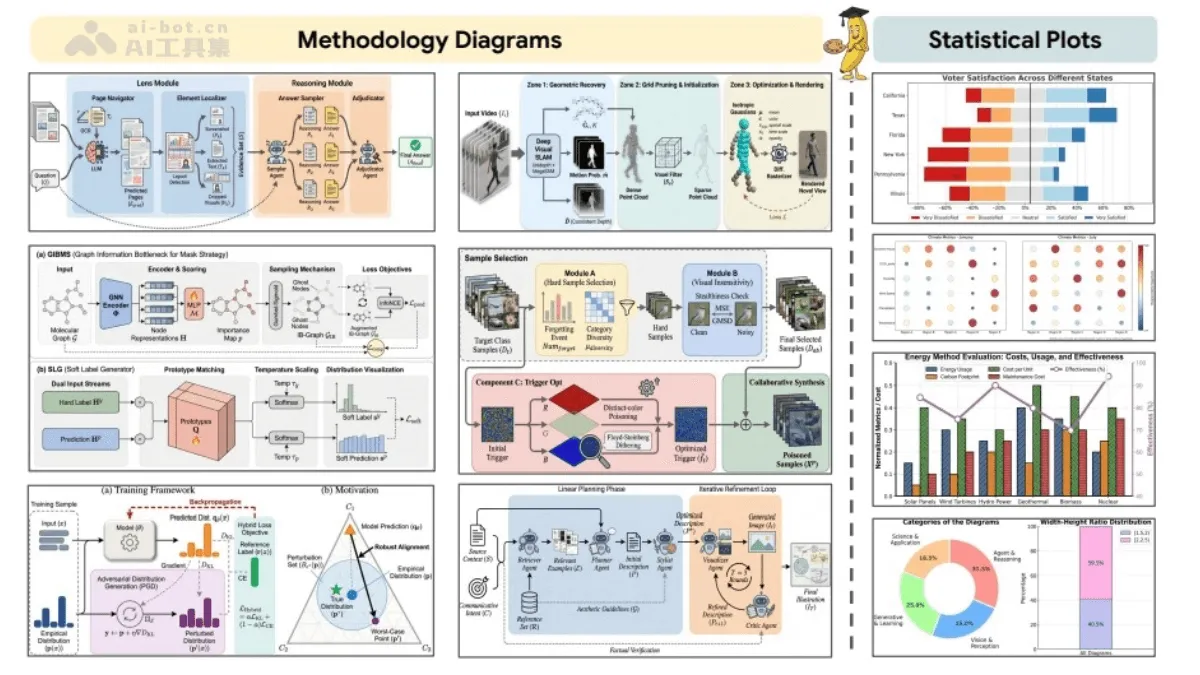
PaperBanana - An AI-powered framework for automatically generating academic illustrations, jointly developed by Peking University and Google
PaperBanana is an automated academic illustration generation framework jointly developed by Peking University and Google Cloud AI Research, addressing the pain point of time-consuming and labor-intensive data creation for AI researchers in academic papers. The system employs an innovative multi-agent collaborative architecture, comprising five specialized agents: Retriever, Planner, Stylist, Visualizer, and Critic.
GLM-5-Turbo - Zhipu launches a base model deeply optimized for OpenClaw
GLM-5-Turbo (codename: Pony-Alpha-2) is a foundational model launched by Zhipu AI, deeply optimized for OpenClaw (lobster) agent scenarios. From the training phase, the model undergoes specific optimizations for core capabilities such as tool invocation, complex instruction compliance, timed and continuous tasks, and high-throughput long-chain processing, addressing the challenges of general-purpose models in real-world agent scenarios.
Claude Opus 4.6 - Anthropic's latest programmable AI model
Claude Opus 4.6 is Anthropic's flagship AI model, an upgrade from Claude Opus 4.5. The model is the first to support an ultra-long context window of 1 million tokens, leading across the board in programming, inference, and complex task processing. Claude Opus 4.6 surpasses Terminal-Bench 2.0, Humanity’s Last...