Unveiling the Dark Horse of Databases Valued at Hundreds of Billions: ByteDance, Alibaba, Tencent, Microsoft, and Tesla All Use It - ZhiDongXi
Zhidx.com (WeChat Official Account: zhidxcom) Author | Cheng Qian Editor | Xin Yuan Riding the wave of AI, an open-source database startup has seen its valuation increase 2.5 times in 7 months, reaching $15 billion (approximately RMB 104.5 billion). ...

Zhidixi (public account: zhidxcom) Author | Cheng Qian Editor | Xin Yuan
Taking advantage of AI, the valuation of an open source database startup increased by 2.5 times in 7 months, and it has already surpassed theUS$15 billion (approximately RMB 104.5 billion).
Zhidongxi reported on February 5 that at the beginning of 2026, the American open source database startup ClickHouse officially announced that it had won the **US$400 million (approximately RMB 2.79 billion)**New financing, valuation surges US$15 billion (approximately RMB 104.5 billion), an increase of about US$6.35 billion (approximately RMB 44.2 billion) from its valuation in May 2025. 2.5 times, its valuation jumped to 100 billion yuan in one fell swoop.
In the field of AI data analysis, ClickHouse is regarded by the industry as a strong competitor to the two giants: Databricks, which NVIDIA has continuously bet on, and Snowflake, which was founded by Oracle veterans. ClickHouse, which was only officially established in 2021, has completed 4 rounds of financing so far, and the cumulative financing amount has exceededUS$1.05 billion (approximately RMB 7.31 billion).
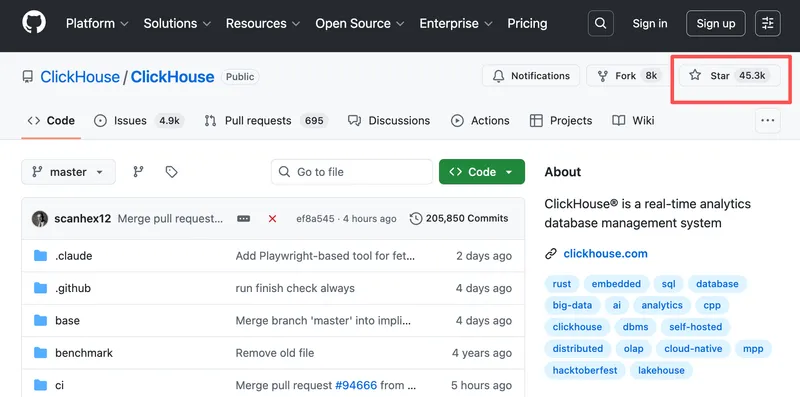
This startup has not only gained favor from the capital market, but its performance in the open source ecosystem is equally impressive. The number of stars on GitHub for its open source database project has reached45290, and with its excellent strength, it has attracted countless star customers around the world. Its clients includeByteDance, Tencent, Alibaba,Meta, Microsoft, Tesla,SoNigeriaWell-known manufacturers at home and abroad, and executives from OpenAI and Anthropic praised ClickHouse. Contributed greatly to the release of GPT-4o and Claude 4.
From the data released by ClickHouse, we can see that compared with the currently popular Snowflake, the cost of ClickHouse is Snowflake’s1/4, the query speed is its 3~5 times, the compression rate is improved 38%.
ClickHouse traces its roots to Russian internet giant Yandex, which was founded 28 years ago. Its founder Alexey Milovidov launched an experimental project within Yandex in 2009 and applied the database to Yandex’s internal Metrica network analysis platform in 2012.
In 2021, Milovidov joined forces with former Salesforce executive Aaron Katz and former Google Vice President of Engineering Yury Izrailevsky to officially spin off ClickHouse from Yandex.
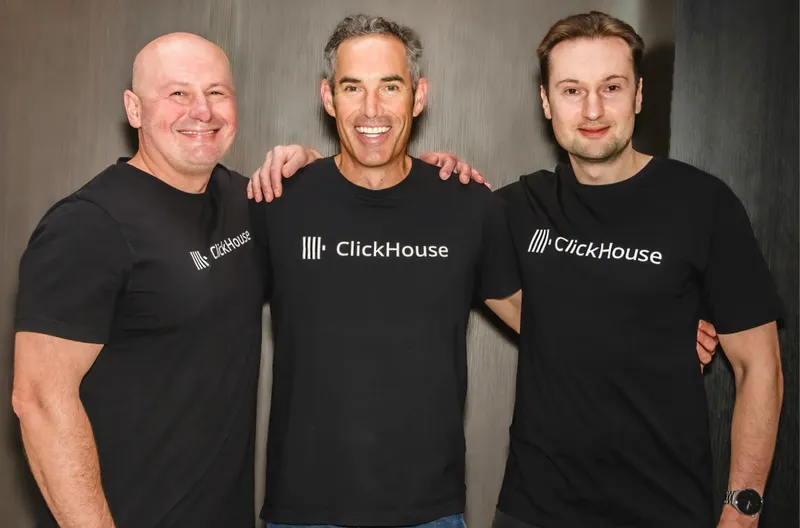
▲From left to right: Yury Izrailevsky, Aaron Katz, Alexey Milovidov
It is worth mentioning that Dragoneer, the leading investor in ClickHouse’s latest financing, has previously invested in ClickHouse competitors such as Datadog, Snowflake and Databricks. Christian Jensen, co-head of private equity investment at Dragoneer, compared various products and said,ClickHouse currently has the best “real-time analytics” capabilities.
Just four years after its establishment, this open source database start-up has been raising funds and winning many major customers around the world. What is so special about it? We tried to find the answer to this question by disassembling ClickHouse’s business system and architecture papers.
1. Obtained 7 billion in financing in 4 years, and ARR increased by more than 250% year-on-year
The creation of ClickHouse, an open source database, can be traced back to 2009.
ClickHouse founder and CTO Alexey Milovidov joined Yandex, Russia’s largest search engine company, in 2008. In 2009, he joined his team to launch an experimental project to generate analysis reports in real time from non-aggregated data. This project is the prototype of ClickHouse.
In 2012, this database was officially launched, but it initially only served Yandex’s internal Metrica network analysis platform. The platform was also the second largest web analytics platform in the world at the time.
The ClickHouse database was not open source until 2016 and will be officially operated independently in 2021. Currently, Milovidov serves as CTO of ClickHouse, Katz is CEO, and Izra Ilevsky is president and is responsible for product management.
What stands out about this database is its ability to extremelyEfficiently ingest hundreds of petabytes of data stored within databases, perform queries on various analysis use cases on these data, and obtain query results in milliseconds. ClickHouse started the giant harvest mode right after its establishment, with financing and big customers coming in droves.
In the same year that it became an independent company, the startup announced that it had received two rounds of financing totaling US$300 million (approximately RMB 2.1 billion), and its valuation jumped toUS$2 billion (approximately RMB 13.9 billion), become a unicorn. In August 2021, ClickHouse announced that it had raised US$50 million (approximately RMB 350 million) in Series A financing, which was completed 2 months later **US$250 million (approximately RMB 1.7 billion)**The new financing was participated by well-known venture capital institution Benchmark and Russian search giant Yandex.
From June 2025 to now, the company has received two huge financings in half a year, with participation from world-renowned investment institutions such as Dragoneer and BVP. It announced at the first user conference OpenHouse in June 2025 that it had obtained **US$350 million (approximately RMB 2.4 billion)**Series C financing was announced on January 17 this year. **US$400 million (approximately RMB 2.8 billion)**New financing. Today, ClickHouse’s valuation has jumped to US$15 billion (approximately RMB 104.5 billion).
The startup’s commercialization has been equally rapid, and its business model is to make money by selling managed cloud services. Katz revealed that the company’s current annualized revenue has reached hundreds of millions of dollars, year-over-year annual recurring revenue (ARR) growth of more than 250%.
2. The query speed is 260 times that of MySQL, with millisecond-level query response
Excellent product strength is the foundation of ClickHouse.
Generally speaking, OLAP and OLTP are core data processing architectures designed for two different business scenarios in the database field. For example, the old database MySQL is an OLTP database, and ClickHouse is an OLAP database.
The difference between the two is that OLTP uses row storage to adapt to high-frequency transaction processing needs, and OLAP uses column storage to achieve efficient data analysis. Nowadays, the ability of real-time query and analysis that can help enterprises achieve real-time decision-making, reduce costs and increase efficiency has almost become a must-have for databases. Therefore, OLAP databases have shown greater application potential at the moment.
Previously, using traditional row storage OLTP databases to process data could take minutes or even hours to get answers. OLAP database can get answers in milliseconds. According to a report by analyst Marko Medojevic, when analyzing a data set containing 11 million records, ClickHouse’s query speed is approximately 10% faster than the OLTP database MySQL. 260 times. This also reflects the advantages of OLAP database to a certain extent.
Specifically, ClickHouse is an open source OLAP database that uses columnar storage. Its functions are similar to Google Analytics. Its goal is to quickly execute analytical queries while processing trillions of rows and petabyte-level data.
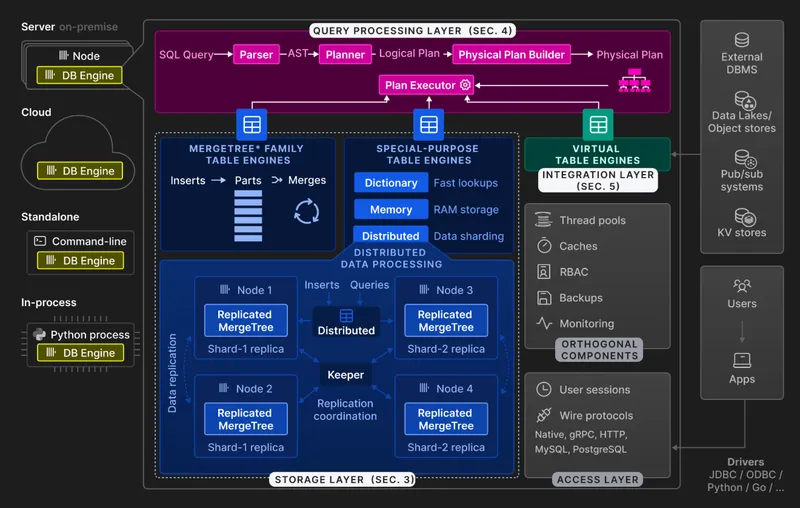
▲The overall architecture of ClickHouse database engine
On the official website, ClickHouse compared several mainstream databases. Among them, the comparison with the AI data analysis platform Snowflake showed that the cost of ClickHouse is only 1/4 of that, but the query speed is increased by 3 to 5 times.
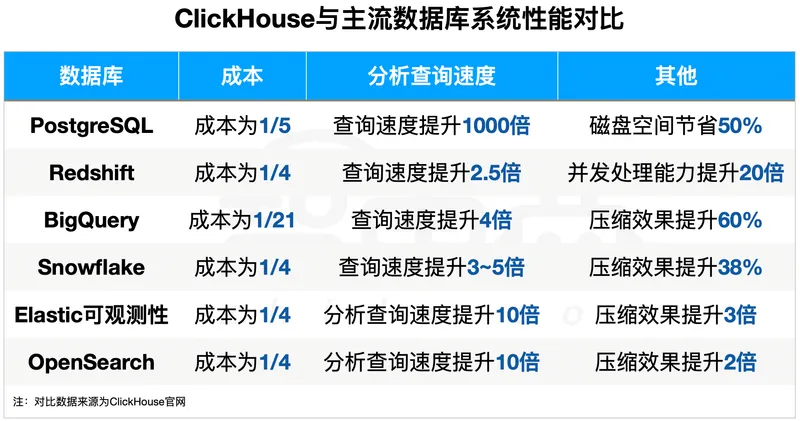
▲Performance comparison between ClickHouse and mainstream database systems (data source is ClickHouse official website, Zhidongxi Tabulation)
For enterprise business systems, databases need to realize efficient integration and processing of massive multi-source data, as well as real-time complex analysis and decision-making support. Faced with many key challenges in this process, ClickHouse’s key features can effectively improve the comprehensive processing capabilities of the database.
For example, the database supports high ingestion rates, adapts to high-concurrency and low-latency query scenarios, is highly open, and is compatible with diverse data storage systems, storage locations, and formats. It is equipped with an easy-to-use query language that supports performance analysis, and can flexibly run on various types of hardware from old laptops to high-performance servers.
These are the key pain points of modern analytical data management systems, and ClickHouse is a database that supports multiple data storage engines. Almost any data source can be imported into the ClickHouse database and supports fast and flexible drill-through analysis. In addition, Katz revealed when he received the first financing that the core difference of ClickHouse is that most open source database tools are developed based on Java, while ClickHouse is written in C++ so it can process large-scale data faster.
Three.Top customer lineup, alsoIt is the key driving force behind GPT-4o and Claude 4.
Although the open source project itself is free, ClickHouse has built a huge business empire on it and has more than 3,000 customers around the world through the fully managed service ClickHouse Cloud.
The customer lineup disclosed by this startup is luxurious, covering domestic and foreign technology giants and top vertical startups, such as domestic leading Internet companies such as Bytedance, Alibaba, and Tencent, domestic automobile leaders such as Changan Automobile, as well as leading overseas manufacturers such as Microsoft, Tesla, Meta, Sony, and Netflix, as well as top startups in the AI field such as OpenAI, Anthropic, Cursor, and Character.ai.
In the field of data processing, domestic Tencent and ByteDance have built their own products based on this open source database.
Tencent Cloud built the Tencent Cloud data warehouse TCHouse-C based on ClickHouse, which can help enterprises quickly build a PB-level real-time data warehouse in a few minutes; the ByteDance R&D team developed ByteHouse technology based on the open source database management system ClickHouse; WeChat currently uses ClickHouse to store log data, because logs usually contain a large amount of repeated content. Using ClickHouse can achieve high compression rates and reduce the storage space occupied by logs.
In the currently popular field of generative AI, ClickHouse has also become the core infrastructure behind Anthropic Claude 4 and OpenAI GPT-4o.
Based on the ClickHouse Cloud architecture, Anthropic has customized a set of exclusive versions suitable for offline isolation environments. From the control plane to the data plane, all core components are independently operated and maintained by Anthropic’s internal team. Anthropic technology R&D engineer Maruth Goyal said, ClickHouse played an important role in helping it develop and launch Claude 4, such as providing high-speed analysis capabilities and flexible data processing solutions for the model.
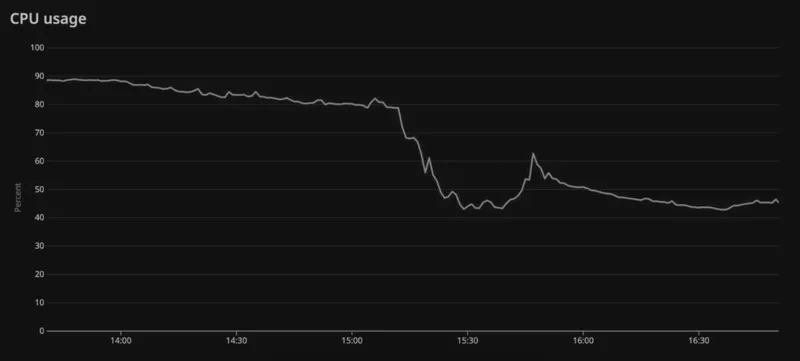
OpenAI engineering manager Akshay Nanavati said that in March 2025, OpenAI officially released the GPT-4o image generation function, and its server was on the verge of collapse, and the system CPU usage instantly surged by 50%. The team quickly expanded the ClickHouse cluster and resolved the crisis.. Based on ClickHouse, the team only modified one line of code to replace the division operation with a combination of multiplication and bit operations, and the system CPU usage immediately dropped by 40%.
However, Katz revealed that ClickHouse is still operating at a loss and is making forward-looking investments. Just on January 17, this startup acquired Langfuse, an open source large language model observability platform. The platform’s products can ensure that the output of the AI system is accurate, safe, and consistent with user intent. The number of GitHub stars for the Langfuse open source project has exceeded 20,000.
Additionally, in October 2025, the company hired Jimmy Sexton, head of investor relations at rival Snowflake, as chief financial officer. However, Katz revealed that ClickHouse is not ready to go public and hopes to improve a few things first.
With new funding in hand, ClickHouse continues to expand its global presence and ecosystem. It entered the Japanese market in 2024 through cooperation with Japan Cloud, a Japanese cloud computing company, and announced a partnership with Microsoft Azure around the unified logical data lake OneLake.
Conclusion: Taking advantage of the AI trend, database manufacturers are accelerating the expansion of AI data
As an important part of AI infrastructure, the importance of AI data analysis platforms is increasing day by day. With the wave of large model training iterations, multi-modal application implementation, and the popularization of enterprise-level AI services, the logs, monitoring, and performance data generated by AI systems have increased exponentially, from petabyte-level data storage to millisecond-level real-time queries, putting forward more stringent requirements for underlying data analysis tools.
The explosive growth of ClickHouse has hit the right time point for large-scale application of AI. With its open source architecture, cloud-native elastic expansion capabilities, efficient indexing mechanism, and native support for SQL, ClickHouse can adapt to the core needs of high concurrent writing, complex query analysis, and full data insight in AI scenarios.
In addition, it can be seen from its acquisition of Langfuse and product upgrades that database startups are expanding their capabilities and providing a more unified data base with real-time data processing capabilities for corporate AI data.
You May Also Like
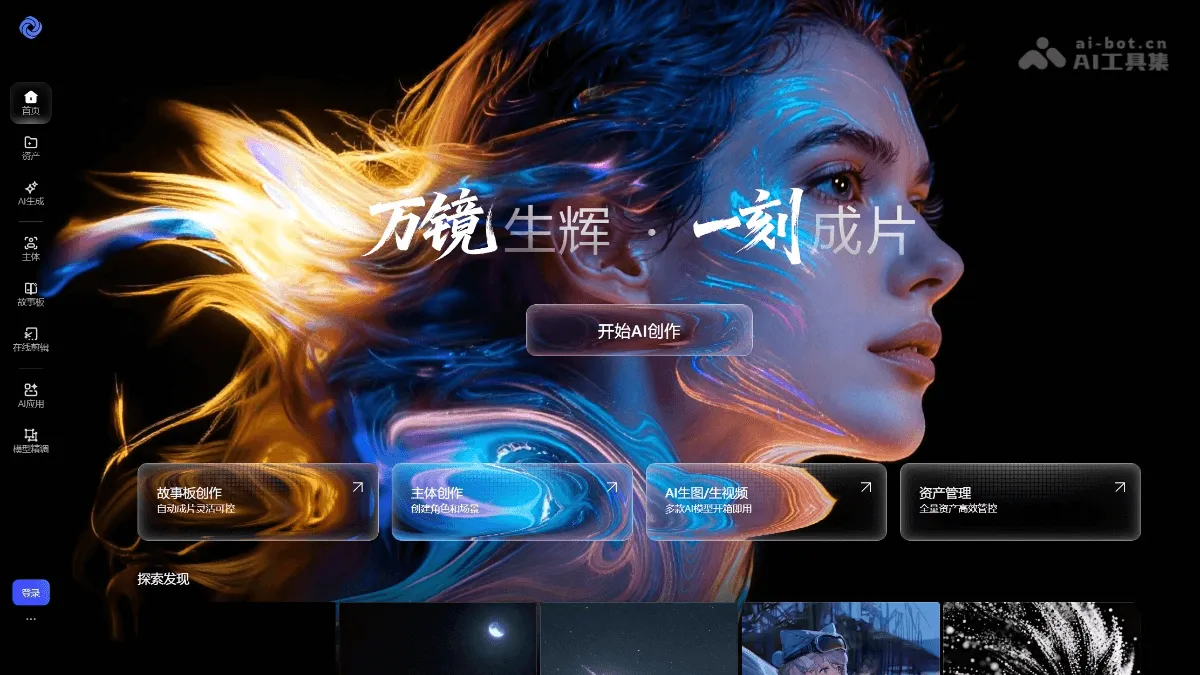
A Moment in a Thousand Mirrors - An AI Video Creation Tool Launched by Alibaba Cloud
What is the "moment of ten thousand mirrors"...?
OpenJarvis - Stanford University's open-source native AI agent framework
OpenJarvis is an open-source, local AI agent framework developed by the Scaling Intelligence Lab at Stanford University. Its core concept is to make AI execution completely localized, with cloud access as an option. The framework provides five main modules: a unified model directory layer, a hardware-aware inference engine, an agent orchestration system, tool memory, and learning optimization. It can be installed with a single click using `pip install openjarvis` and offers four interaction methods: browser, desktop application, Python SDK, and CLI.
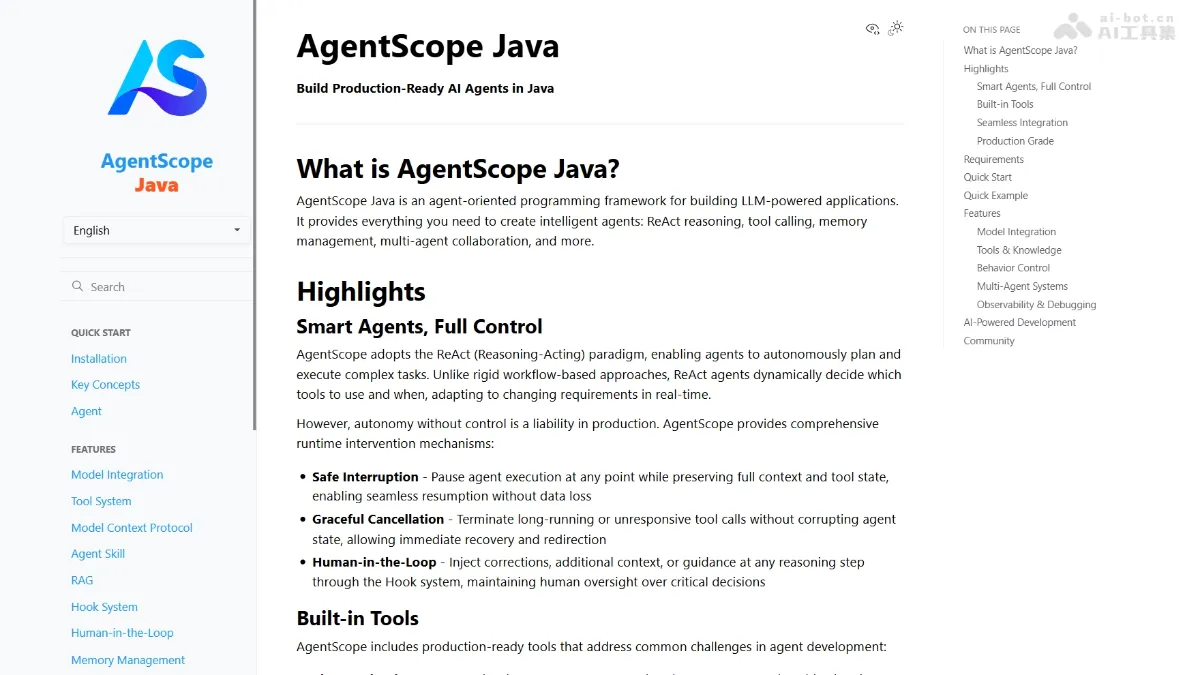
AgentScope Java - Alibaba's open-source enterprise-level intelligent agent development framework
AgentScope Java is an open-source Java framework from Alibaba for developing enterprise-level intelligent agents, enabling Java developers to easily build production-grade AI applications. The framework adopts the leading ReAct paradigm, giving large models autonomous reasoning and planning capabilities, while providing a robust runtime control mechanism to ensure a balance between autonomy and controllability.

Claude Sonnet 5 is about to be released! Performance may approach Opus 4.5, cost only half
Anthropic's Claude Sonnet 5 model is expected to be released soon. This news had already leaked last Sunday. GitHub AI engineer Dan McAteer posted on social media at the time: "Anthropic will release Claude Sonnet 5 this week, and says it could bring disruptive changes."